


 The Ripon Rabbit
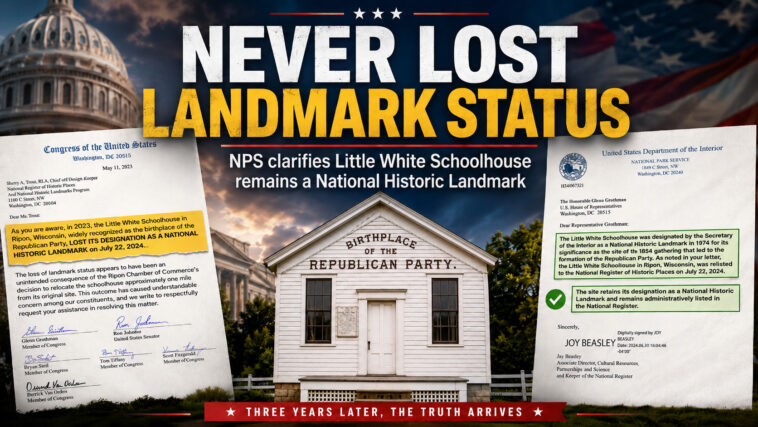
Federal records reveal how a carefully worded warning became a false declaration, was repeated to Congress, and may still leave the relocated schoolhouse open to future review
For more than three years, the public has been handed competing versions of what happened to Ripon’s Little White Schoolhouse after it was lifted from its foundation and relocated in April 2023.
We were told the move had received the necessary approvals.
It had not.
We were told the federal government supported the relocation.
It did not.
We were told the schoolhouse would automatically lose both its National Register listing and its National Historic Landmark designation.
It did not.
And now, after seven members of Wisconsin’s congressional delegation wrote to Washington asking the National Park Service to restore the schoolhouse’s supposedly lost Landmark status, the federal government has finally stated the truth in plain language:
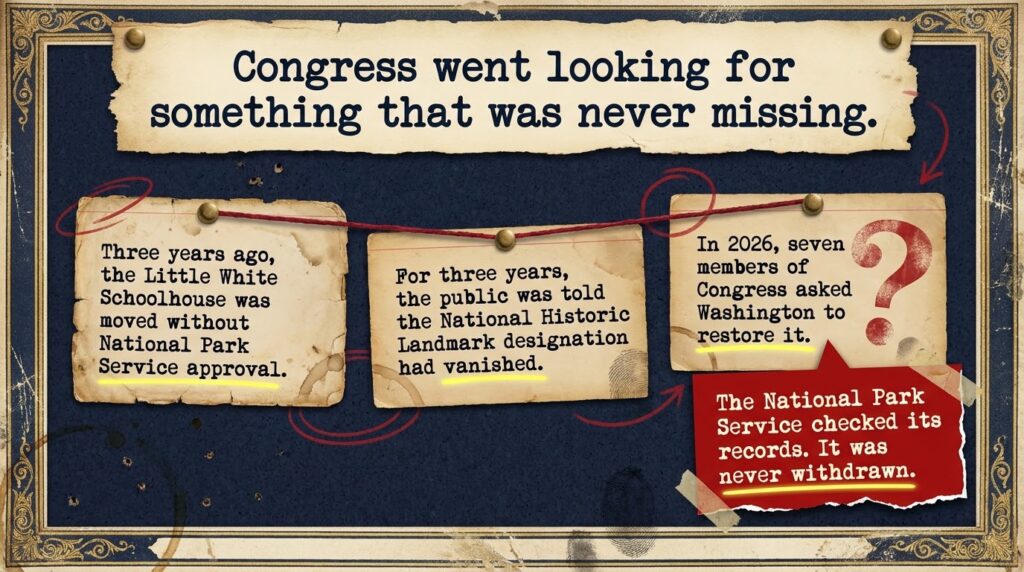
“The site retains its designation as a National Historic Landmark.”
Not restored.
Not reinstated.
Not reconsidered.
Retains.
The designation never went away.
But that does not necessarily mean the controversy is over.
The same 2023 federal correspondence that proves the Landmark designation was not automatically lost also warned that the move could someday trigger a formal review by the Secretary of the Interior.
So the truth is more complicated than either side has publicly acknowledged.
The Little White Schoolhouse remains a National Historic Landmark today.
That designation was never formally withdrawn.
But the relocated building may still face a future federal review over whether its new location, setting and surrounding development have damaged the qualities that supported its Landmark designation in the first place.
The paper trail now allows us to understand how the confusion began, how it spread and why the final chapter may not yet have been written.
THE LETTER FROM CONGRESS
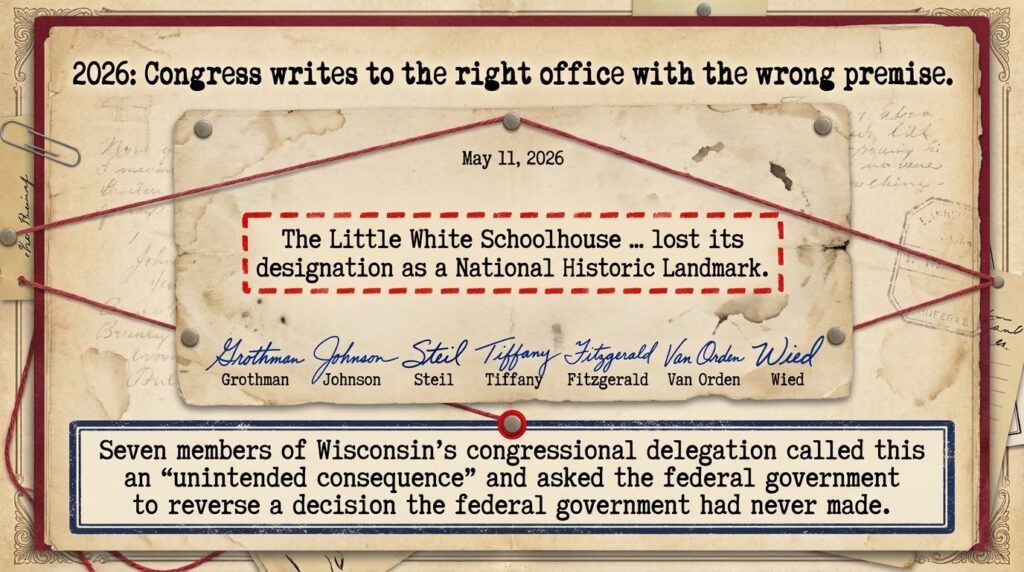
On May 11, 2026, Congressman Glenn Grothman, Senator Ron Johnson and Representatives Bryan Steil, Tom Tiffany, Scott Fitzgerald, Derrick Van Orden and Tony Wied jointly wrote to Sherry Frear, Chief and Deputy Keeper of the National Register of Historic Places and National Historic Landmarks Program.


Their letter stated:
“As you are aware, in 2023, the Little White Schoolhouse in Ripon, Wisconsin, widely recognized as the birthplace of the Republican Party, lost its designation as a National Historic Landmark.”
The delegation attributed that supposed loss to the Ripon Chamber of Commerce’s decision to relocate the schoolhouse approximately one mile from its former location.
They described the loss of Landmark status as an “unintended consequence” and asked the National Park Service to give prompt and favorable consideration to restoring the designation.
There was only one problem.
No one had ever withdrawn it.
THE NATIONAL PARK SERVICE RESPONDS
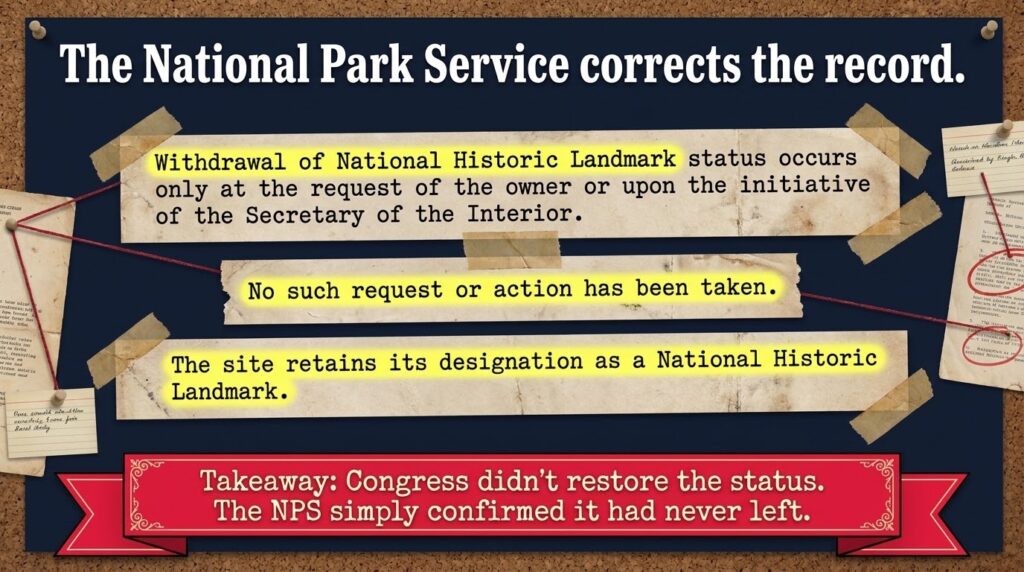
On June 30, 2026, Joy Beasley, Associate Director for Cultural Resources, Partnerships and Science and Keeper of the National Register, responded directly to Grothman.
Little-White-Schoolhouse-Response-for-Rep-GrothmanThe answer was concise:
“Withdrawal of National Historic Landmark status occurs only at the request of the owner or upon the initiative of the Secretary of the Interior.”
Beasley then delivered the sentence that changes the public understanding of the entire controversy:
“No such request or action has been taken; accordingly, the site retains its designation as a National Historic Landmark and remains administratively listed in the National Register.”
There was no restoration.
There was nothing to restore.
The congressional delegation had asked the federal government to reverse a decision the federal government had never made.
But that answer does not mean the new location has been formally approved as fully preserving the property’s Landmark integrity.
It means only that no formal withdrawal proceeding has occurred.
That distinction is critical.
WHAT THE FEDERAL GOVERNMENT ACTUALLY SAID IN 2023
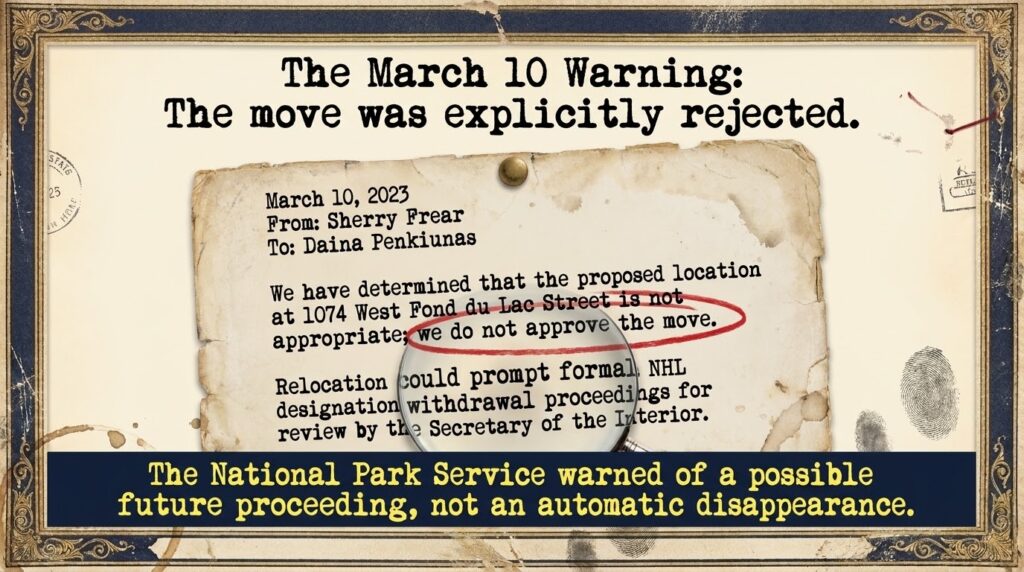
On March 10, 2023, Sherry Frear wrote to Daina Penkiunas, Wisconsin’s State Historic Preservation Officer, regarding the proposed relocation.
Frear’s letter addressed both federal designations associated with the property:
Its listing in the National Register of Historic Places
and its separate designation as a National Historic Landmark.
Those are related programs, but they are not the same thing.


The federal letter clearly warned that the proposed relocation had not been approved:
“We have determined that the proposed location at 1074 West Fond du Lac Street is not appropriate; we do not approve the move.”
It then explained the immediate consequence:
“The property will be automatically deleted from the National Register if/when moved.”
That warning was direct.
The schoolhouse had already been moved in the past, and its continued federal listing depended heavily upon the integrity of its location, setting and historic context.
The National Park Service concluded that the proposed commercial location would not adequately preserve those qualities.
But when Frear addressed the schoolhouse’s National Historic Landmark designation, the language changed.
The letter did not say Landmark status would automatically disappear.
Instead, it stated:
“Because the Little White Schoolhouse was separately designated as a National Historic Landmark in 1974, the proposed relocation also potentially threatens that status.”
The key word is potentially.
Frear continued:
“Relocation of the Little White Schoolhouse could prompt formal NHL designation withdrawal proceedings for review by the Secretary of the Interior.”
That was not an automatic cancellation.
It was a warning that the move could trigger a separate federal process.
That process never occurred.
At least not yet.
TEN DAYS LATER, THE LANGUAGE CHANGED
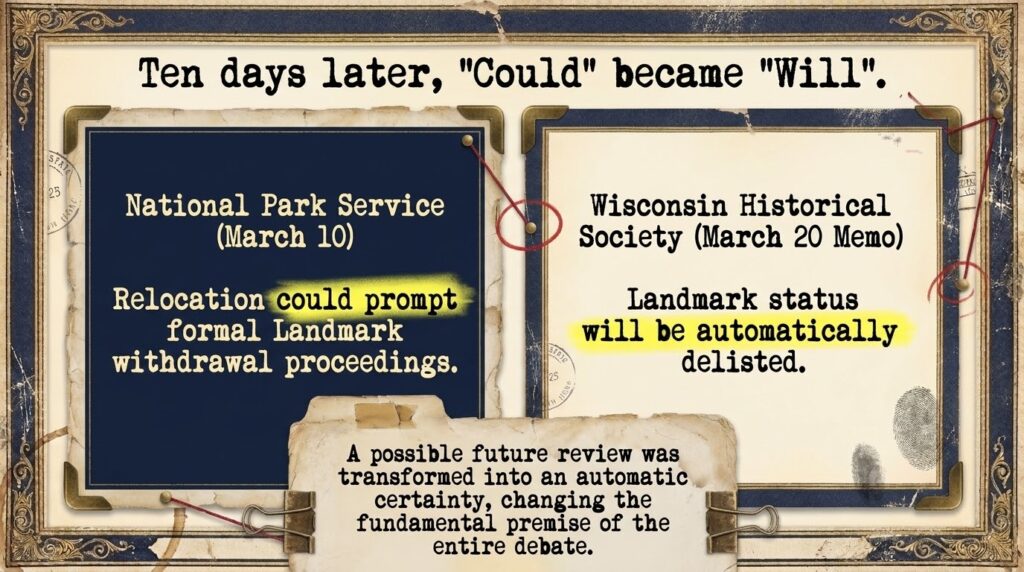
On March 20, 2023—the anniversary of the 1854 schoolhouse meeting—the Wisconsin Historical Society distributed a memorandum to “Local, State, and National Officials.”
The memo correctly stated that the federal government did not approve the move.
But then it declared:
“As a result, they do not approve the move to this site, and the property will be automatically delisted from the National Register and National Historic Landmark status if it is moved.”
That was not what the federal letter said.
The National Park Service said the National Register listing would be automatically affected.
It said the National Historic Landmark designation was potentially threatened and that relocation could prompt formal withdrawal proceedings before the Secretary of the Interior.
The Wisconsin Historical Society converted two separate consequences into one sweeping declaration.
“Could prompt formal proceedings” became:
“Will be automatically delisted.”
That appears to be the point where careful federal language became years of public confusion.
THE DISTINCTION WAS NOT A TECHNICALITY
Some may dismiss this as bureaucratic wordplay.
It is not.
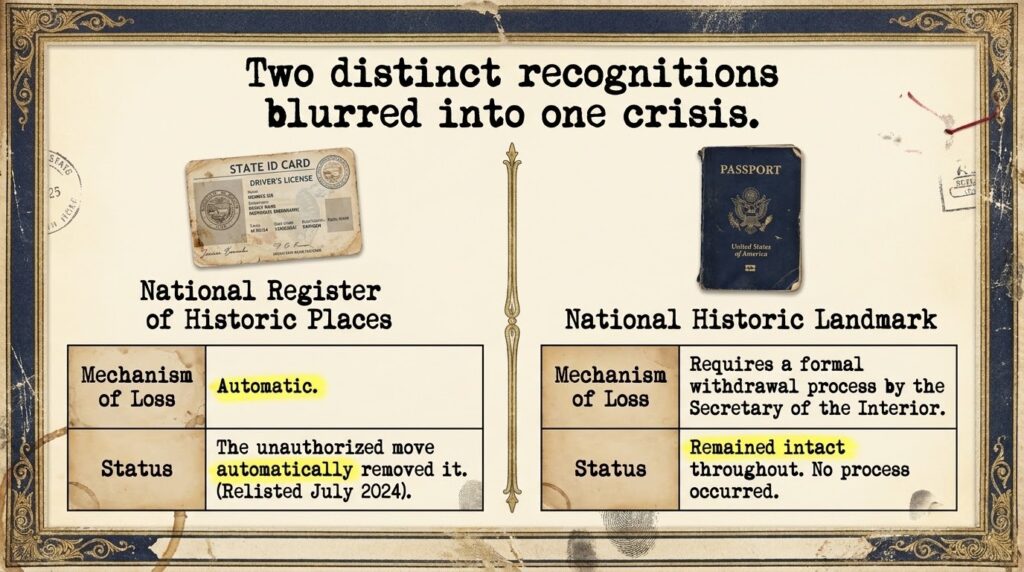
The National Register of Historic Places is the nation’s official list of historic properties considered worthy of preservation.
A National Historic Landmark designation is a separate and higher federal recognition reserved for properties judged to possess exceptional national significance.
A property may lose one status without automatically losing the other.
The difference is similar to a person having both a driver’s license and a passport.
Both are government-issued identification.
Both may contain similar information.
But losing one does not automatically cancel the other.
In this case, the schoolhouse was automatically removed from the National Register following the unauthorized move.
Its Landmark designation remained intact because no formal withdrawal was initiated by the owner or the Secretary of the Interior.
The schoolhouse was later relisted in the National Register on July 22, 2024.
Its National Historic Landmark designation remained in place throughout.
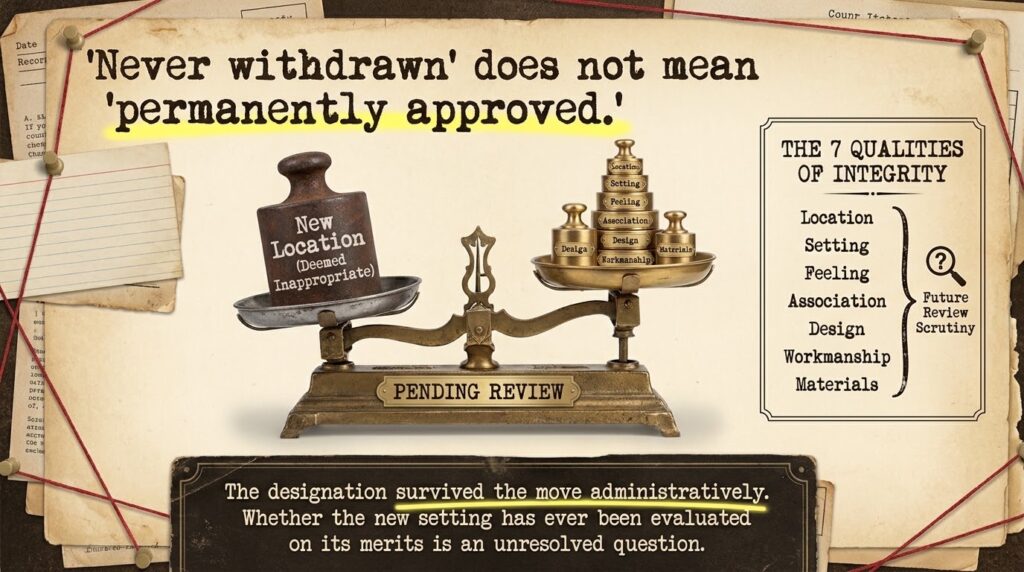
BUT “NEVER WITHDRAWN” DOES NOT MEAN “PERMANENTLY APPROVED”
This is where the newest federal letter must be read carefully.
The National Park Service confirmed that the Landmark designation was never withdrawn.
It did not declare that the new location had passed a formal Landmark integrity review.
It did not state that the relocated property is permanently immune from future reconsideration.
It did not retract the warning issued in March 2023.
That warning remains part of the record:
“Relocation of the Little White Schoolhouse could prompt formal NHL designation withdrawal proceedings.”
The Secretary of the Interior may still initiate a restudy of an existing National Historic Landmark.
For a property designated before 1980, such a review could examine whether the qualities responsible for its original designation have been lost or destroyed.
That question may include more than whether the building itself physically survived the move.
Historic integrity can also involve:
- location,
- setting,
- feeling,
- association,
- design,
- materials,
- workmanship.
The schoolhouse may remain architecturally intact.
But the federal concern was never limited to its walls, windows and roof.
It involved the historic environment surrounding the building and whether the new commercial setting could still communicate the significance for which the property was designated.
The 2026 response confirms only that no withdrawal proceeding has taken place.
It does not eliminate the possibility of one in the future.
THE MOVE WAS NOT APPROVED

The correspondence also destroys any remaining suggestion that the federal government had approved the relocation.
Frear’s March 10 letter stated:
“We do not approve the move.”
Those words are not ambiguous.
They do not mean conditional approval.
They do not mean reluctant approval.
They do not mean approval pending additional paperwork.
They mean exactly what they say.
The move was not approved.
Yet during the September 7, 2022 meeting of the Ripon Historic Preservation Commission, officials were told that federal and state authorities had already approved moving the schoolhouse.
One commissioner said:
“The feds already have approved moving it.”
Another statement followed:
“The state has already said it could be moved.”
Neither statement was true.
The later federal correspondence proved it.
The Chamber proceeded anyway.
THE CONSEQUENCE WAS NOT UNEXPECTED
The congressional letter describes the loss of status as an “unintended consequence.”
That characterization is difficult to defend.
Before the schoolhouse was moved, the National Park Service specifically warned:
“The property will be automatically deleted from the National Register if/when moved.”
The Wisconsin Historical Society then distributed its own warning to local, state and national officials.
Whatever confusion existed over the separate Landmark designation, no one could reasonably claim ignorance of the threat to the National Register listing.
The consequence was written down.
It was distributed.
It was known before the move.
The Chamber chose to relocate the building regardless.
That may have been a calculated decision.
It may have been viewed as a necessary tradeoff.
It may even have been supported by people who believed the new site offered greater visibility, access and educational use.
But it was not an unforeseen surprise.
HOW THE FALSE PREMISE REACHED CONGRESS
The 2026 congressional letter did not emerge from nowhere.
Someone approached the delegation.
Someone described the history.
Someone told the offices of seven elected officials that the schoolhouse had lost its National Historic Landmark designation.
Someone prepared or supplied the claim that Congress needed to help restore it.
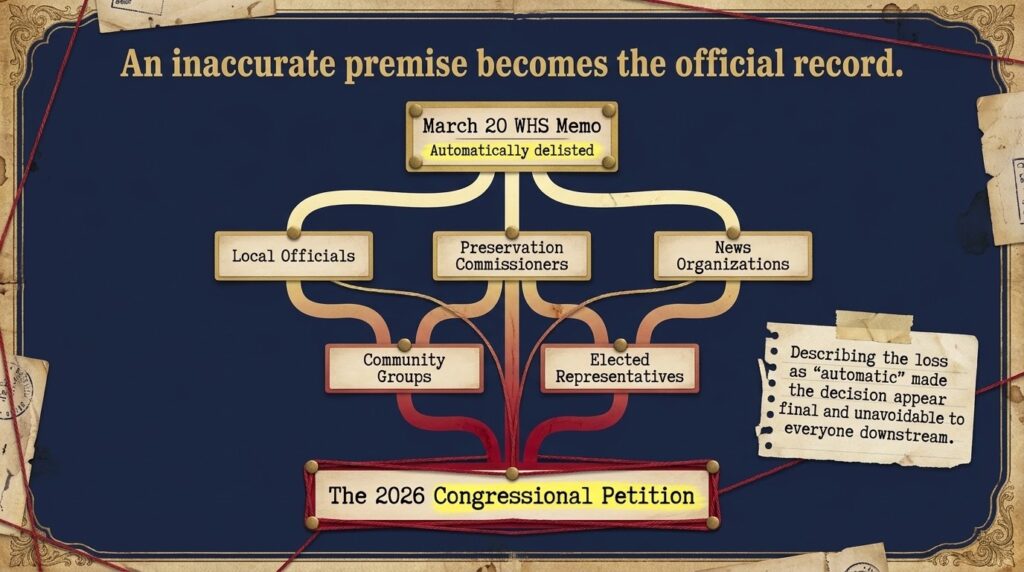
We now know that a Wisconsin Historical Society memorandum from March 20, 2023, contained nearly that exact premise.
That does not prove the Wisconsin Historical Society directly requested the congressional letter.
It does show that the false claim existed in an official state document circulated to local, state and national officials three years earlier.
The likely chain is now visible:
The National Park Service issued a precise warning.
The Wisconsin Historical Society broadened that warning.
Local officials and the public were told that both designations would automatically disappear.
The building was moved.
The National Register listing was lost.
The Landmark designation remained intact.
Three years later, the same misunderstanding was apparently repeated to Wisconsin’s congressional delegation.
Congress asked Washington to restore a designation Washington had never withdrawn.
The National Park Service checked its records and corrected the premise.
GROTHMAN WROTE TO THE RIGHT OFFICE
Grothman’s letter was directed to the correct administrative program.
Sherry Frear leads the National Register of Historic Places and National Historic Landmarks Program—the same office that issued the detailed federal warning before the move.
It was an appropriate office to contact for clarification, review or assistance.
But only the Secretary of the Interior holds the authority to formally withdraw National Historic Landmark status.
That creates another revealing point.
Had the Landmark designation truly been withdrawn, there should have been a formal federal record.
There should have been notice.
There should have been a Secretarial action.
There should have been documentation of the withdrawal process.
There was none.
Because the designation had never been withdrawn.
THE PUBLIC DID NOT HAVE THESE RECORDS

There is another part of this history that should not be forgotten.
These letters were not simply placed before the public as part of a transparent discussion before the move.
They were uncovered through open-records requests.
Citizens had to ask.
They had to search.
They had to obtain the correspondence after official meetings had already included inaccurate claims about federal and state approval.
The National Park Service’s March 10 letter was not vague.
It said the new location was inappropriate.
It said the move was not approved.
It said the schoolhouse would be automatically removed from the National Register if relocated.
It warned that its separate National Historic Landmark status could face formal review.
That information should have been placed directly before the community.
Instead, the building was moved on April 17, 2023, and the public was left to unravel the consequences afterward.
THE REAL STORY IS BIGGER THAN A DESIGNATION
This controversy has never been only about whether the schoolhouse appeared in one federal database or another.
It is about public process.
It is about whether government officials and private organizations presented accurate information before making an irreversible decision involving a nationally significant historic property.
It is about whether the public was allowed to see the same warnings decision-makers had received.
It is about the difference between preservation and relocation.
It is about the difference between expanding educational opportunities and rewriting the record to justify a predetermined outcome.
And it is about accountability.
When officials say approval was granted, the public should be able to see the approval.
When officials say a designation was lost, the public should be able to see the withdrawal.
When members of Congress ask a federal agency to restore something, their constituents should be able to trust that someone first confirmed it was actually gone.
And when the National Park Service says a relocation may threaten Landmark integrity, the public deserves to know whether that concern has ever been formally resolved.
WHAT WE NOW KNOW
Three years later, the record allows several conclusions to be stated with confidence.
The National Park Service did not approve the proposed move.
The schoolhouse was moved anyway.
The move caused the building to be automatically removed from the National Register of Historic Places.
The Wisconsin Historical Society incorrectly stated that National Historic Landmark status would also be automatically lost.
No owner request or Secretarial action formally withdrew the Landmark designation.
The schoolhouse was relisted in the National Register on July 22, 2024.
Its National Historic Landmark designation remained intact throughout.
Seven members of Wisconsin’s congressional delegation were later persuaded to ask NPS to restore the designation.
NPS responded that it had never been withdrawn.
But the 2023 federal warning remains unresolved.
The new location may still be subject to a future review of whether the schoolhouse retains the historic integrity required of a National Historic Landmark.
THE QUESTION HAS CHANGED
The question is no longer:
How can the Little White Schoolhouse regain its National Historic Landmark status?
It never lost it.
The questions now are:
- Who gave Congress the incorrect information?
- Did the congressional offices receive the original March 10, 2023 NPS letter?
- Were they shown the Wisconsin Historical Society’s inaccurate March 20 summary?
- Did anyone check whether the Secretary of the Interior had actually withdrawn the designation?
- Why was the absence of a formal withdrawal not discovered before seven federal lawmakers signed their names?
- Has the relocated schoolhouse ever undergone a complete federal review at its new location?
- Does the National Park Service consider the matter closed?
- Or could the setting, location and surrounding commercial development still trigger the formal withdrawal proceedings first warned about in 2023?
THE TRUTH DID NOT CHANGE—IT WAS FINALLY ACKNOWLEDGED
For three years, this story has been buried beneath official assurances, selective explanations and carefully blurred distinctions.
The latest federal response does not rewrite the history.
It exposes it.
The Little White Schoolhouse was moved without National Park Service approval.
Its National Register listing was lost exactly as officials had been warned.
Its separate National Historic Landmark designation was never withdrawn.
The Wisconsin Historical Society’s claim that both statuses would automatically disappear was wrong.
Congress later repeated the same false premise.
And the National Park Service has now corrected the record.
The Little White Schoolhouse remains what it has been since 1974:
A National Historic Landmark.
But remaining designated today is not the same as receiving permanent approval for the new location.
The building survived.
The designation survived.
The documents survived.
And three years later, the truth finally caught up with the story.
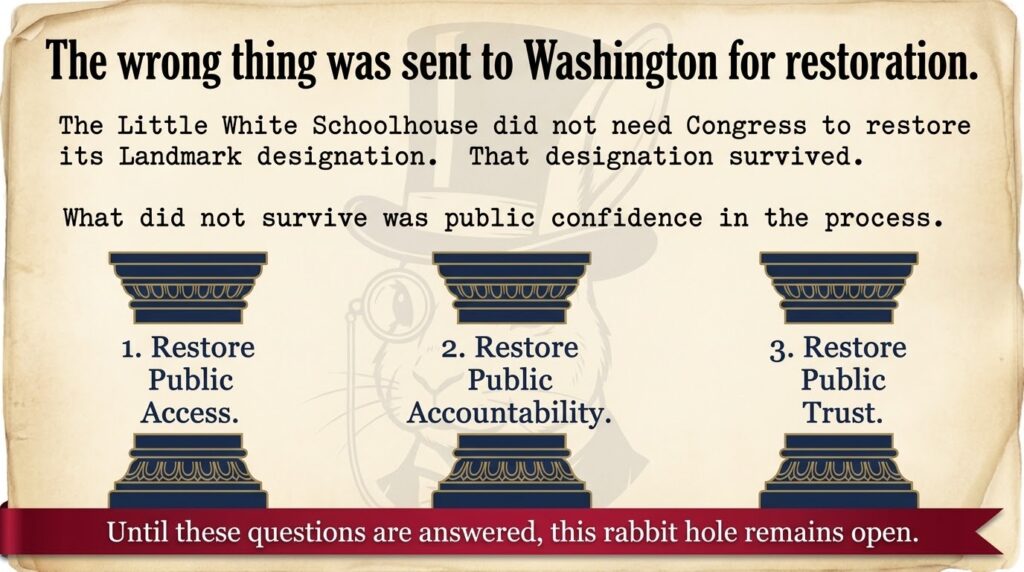
What remains to be restored is not the Landmark designation.
It is public trust.
And what remains unanswered is whether the federal review warned about before the move is still waiting somewhere ahead. Being prepared for that moment ahead of time, just makes common sense. Wouldn’t you agree?
SEE ALSO LIVE BROADCAST AND AJ’S SPECIAL UPDATE SHOW: