

 The Ripon Rabbit
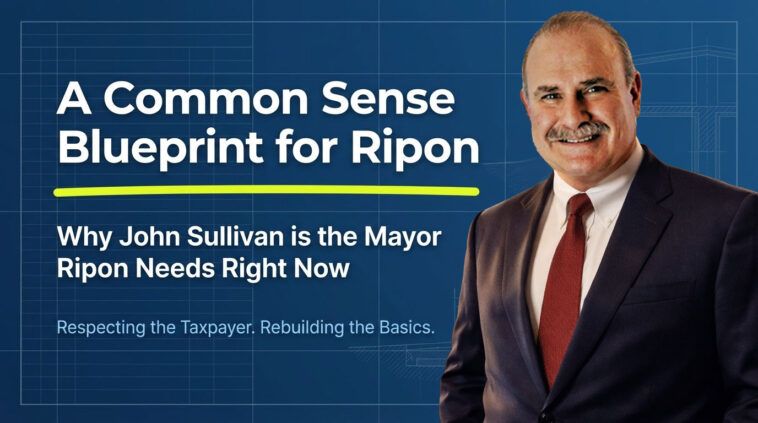
My in-depth interview with Ripon mayoral candidate John Sullivan made one thing unmistakably clear: his campaign is not built around flashy slogans or polished talking points. It is built around a blunt argument that many Ripon citizens already feel in their gut — taxpayers are paying too much, getting too little, and being treated like spectators in their own city.
Sullivan’s core message is simple: Ripon does not have a revenue problem nearly as much as it has a priorities problem.
City Hall has drifted into a pattern of borrowing, overbuilding, outsourcing, and dressing up surface problems while deeper structural issues remain unresolved.
Roads get patched, but the utility problems underneath remain. Money appears for projects that look impressive, but not for the unglamorous basics that actually determine long-term quality of life.

The message is that Ripon taxpayers are carrying some of the highest taxes and fees in the county while still watching essential services fall behind.
Sullivan frames the problem not simply as rising costs, but as a deep disconnect between what citizens pay and what they receive. He also ties that frustration to debt, vanity spending, and a public meeting culture that leaves citizens feeling dismissed rather than heard.

Sullivan’s biography is not presented as a ceremonial résumé. It is presented as an explanation for why he sees city government differently. His background in farming, banking, finance, audits, fraud detection, and real estate becomes the backbone of his argument that he knows how to find waste and identify when the numbers do not make sense.
For Ripon voters, might answer the question: why should we trust him to go line by line through city spending?

Sullivan describes a breaking point created by more taxes, poor snow response, and a public hearing process that, in his view, cuts citizens off rather than listens to them. His decision to run is framed as a reaction to a city government that appears too comfortable extracting more from taxpayers while limiting their voice.
The argument is simple and powerful: when leadership stops listening, citizens need new leadership.

This may have the clearest take away from our talk because it lays out the race as a direct choice. On one side is the status quo: borrowing, consultant dependence, temporary fixes, and top-down governance.
On the other side, what I call the Sullivan Way: audits, spending discipline, debt reduction, foundational infrastructure work, in-house oversight, and unrestricted public transparency. It gives voters a clean side-by-side contrast instead of vague campaign language.

Then Sullivan sharpened the critique. He pointed to budget overruns, demolition costs, equipment bloat, and police staffing questions as examples of a city government that has become too comfortable with excess.
The key point is not just that bad decisions have been made. It is that Ripon may have drifted into a culture where overbuilding, overspending, and overstaffing no longer trigger enough resistance. Sullivan’s proposed corrections are meant to restore discipline where he believes discipline has been lost.

An argument can be made that Ripon has allowed too much taxpayer money to pass through too many outside hands.
Sullivan’s case is that when consultants, subcontractors, and outside layers all take a cut, citizens end up paying more while accountability becomes weaker. His alternative is direct local oversight through an in-house city engineer who works exclusively for Ripon taxpayers. Whether voters agree with every detail or not, the broader appeal is clear: less outsourcing, more ownership.

This is one of the strongest visual metaphors. Sullivan contrasts cosmetic roadwork with the deeper problems underneath; lead lines, storm water, culverts, and failing infrastructure. His point is that city government too often rewards visible short-term improvements while neglecting the expensive but necessary work below the surface. In plain terms, this is a warning against governing for appearances instead of durability.

Continuing the infrastructure message, the larger takeaway is economic as well as mechanical. Sullivan is arguing that when a city fixes its true foundations, property values rise more naturally and public confidence improves.
In other words, solid infrastructure is not just maintenance; it is a long-term investment in Ripon’s stability, attractiveness, and tax base. That is a more serious vision than simply chasing projects that photograph well.

This portion of the blueprint reinforces a larger theme running through the entire discussion: government should not merely ask citizens for trust, it should operate in a way that earns it.
The emphasis is on oversight, transparency, and creating structures that make waste and disconnect harder to hide. Sullivan’s larger message is that reform has to be systemic. You do not fix public distrust with better slogans; you fix it with better governance.

The message is no longer about isolated complaints. It is about a governing philosophy. Sullivan is laying out a reset in priorities: less performance, more stewardship; less drift, more discipline; less insulation at City Hall, more responsiveness to the people paying the bills.
That framing matters because it turns his candidacy into something bigger than one election cycle. It becomes an argument about the future culture of Ripon government.

The final takeaway from the blueprint is that this race is not merely about replacing one name with another. It is about whether Ripon citizens want more of the same habits or a more aggressive return to basic governance principles.
Sullivan’s appeal is rooted in a simple promise: fix the foundation, cut the waste, respect the taxpayer, and restore the citizen’s voice. For voters who believe City Hall has grown too distant from everyday reality, that may be the most important message in the race.
This race comes down to a simple question: should Ripon double down on the current model, or get back to disciplined, taxpayer-first leadership?
On April 7, the voters decide whether the city stays on autopilot or takes a hard look at its priorities.
That just makes common sense. Wouldn’t you agree?
LISTEN TO MY LIVE INTERVIEW WITH JOHN BELOW