


 The Ripon Rabbit
This report aims to advance a clear and provocative argument: that Wisconsin’s absentee-by-mail voting system creates a measurable breakdown in ballot chain of custody, and that the scale of unreturned ballots in the 2026 Spring Election should be viewed not as a harmless clerical byproduct, but as a warning sign of systemic weakness.
The opening headline establishes my tone immediately. I present the data itself as a forensic briefing. That word choice matters. “Forensic” suggests method, evidence, structure, and investigation.
Wishing to signal that you the reader is meant to see the enclosed material not as emotional rhetoric, but as an analytical breakdown of a measurable problem.
The phrase “ballot gap” is also strategically chosen. It shifts the conversation away from abstractions about election trust and into something more concrete: the difference between ballots issued and ballots returned.
That is the heart of my thesis. It does not begin by claiming fraud. It begins by highlighting a gap in closure.
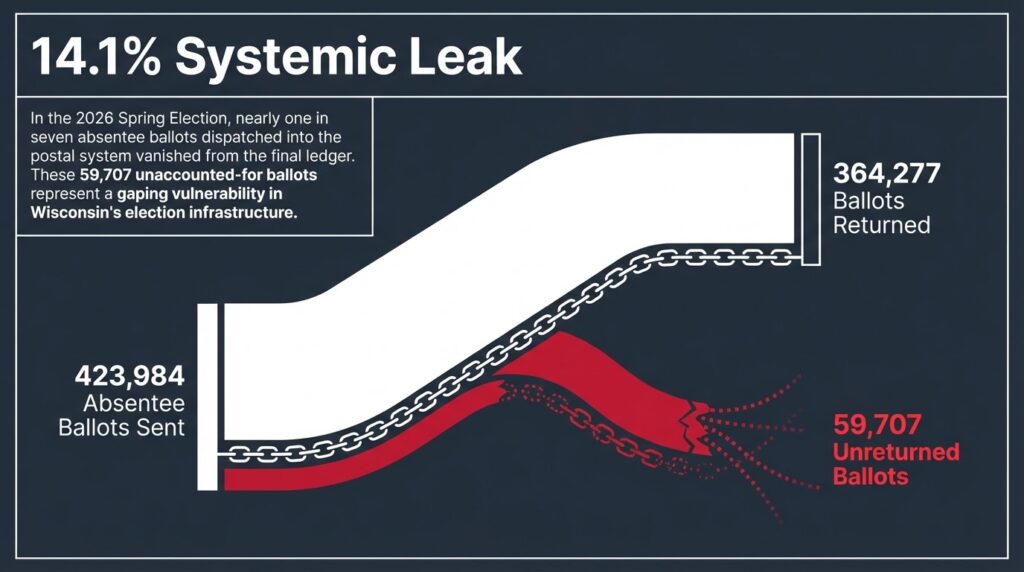
The phrase “systemic leak” is deliberately strong. It suggests not a one-time mistake, but a structural and recurring property of the system itself.
This data defines the core argument. The claim here is not that 59,707 ballots were illegally cast. The claim is that 59,707 live ballots were sent into circulation and did not close the loop.
That distinction is crucial.
An investigative reader should note that “unreturned” can encompass many possibilities: voters who changed their mind, ballots misplaced in homes, ballots sent to outdated addresses, ballots delayed, ballots discarded, or ballots otherwise never completed.
But the point really is that regardless of the explanation, the system generated a large zone of unresolved ballot movement.
In most secure systems, a 14.1% unresolved exit rate would not be casually waved away.
I want you to think about that.
Think of ballots not as casual mail pieces, but as sensitive civic instruments whose custody matters.
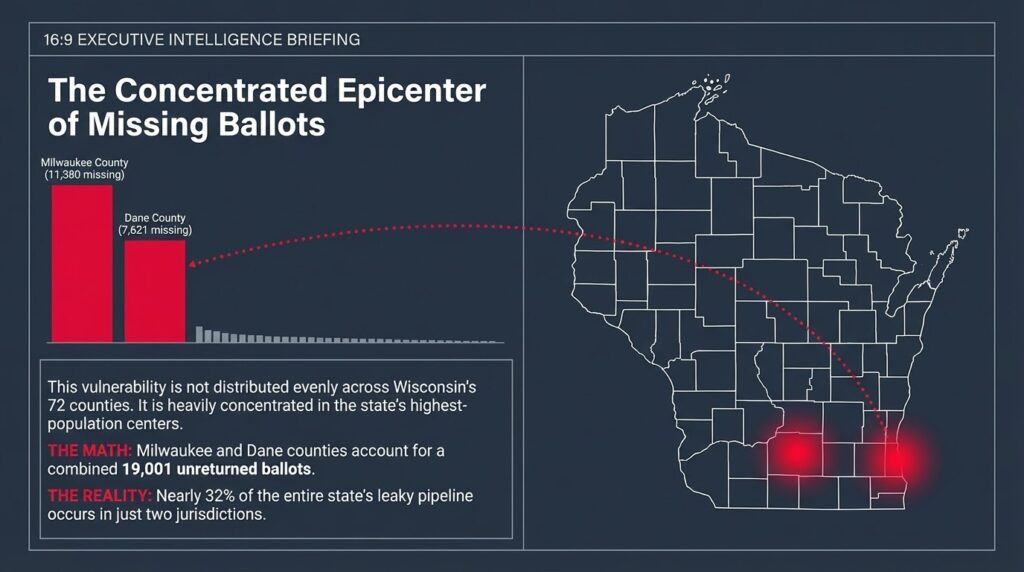
A statewide number can sometimes be dismissed as diffuse background noise. But when a large share of the issue clusters in a handful of counties, the anomaly begins to look less random and more structural.
I would like to ask why these concentrations exist. Are they the natural result of population density? Are they tied to more transient housing patterns, urban delivery complications, higher absentee volume, outdated registries, or administrative handling challenges?
We may never see any resolve that question, but it uses concentration itself as evidence that the problem deserves closer scrutiny.
This is not happening nowhere. It is happening somewhere, and happening heavily.
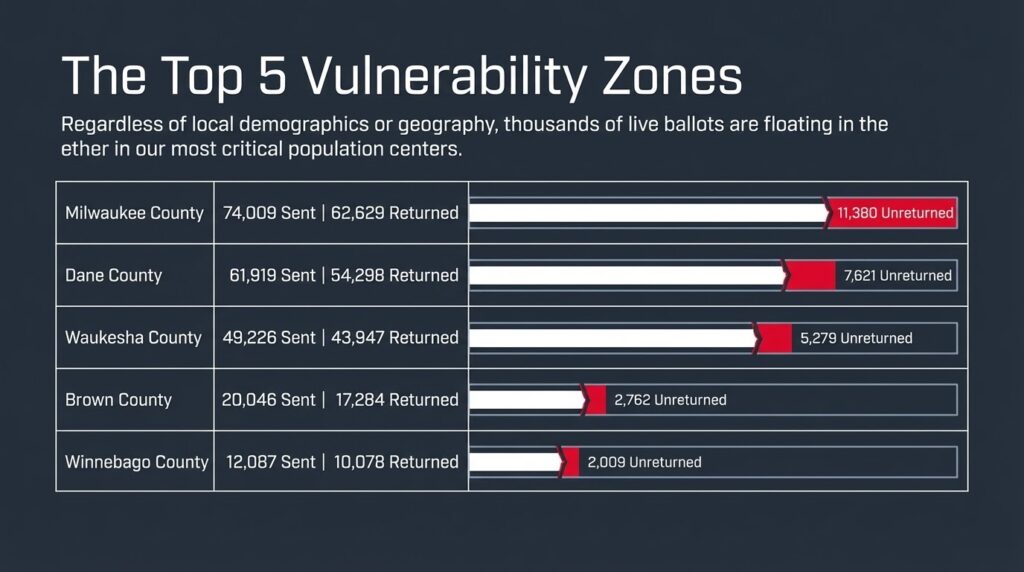
This data prevents the argument from becoming a simple urban-versus-rural cliché. Milwaukee and Dane are the largest standouts, but Waukesha, Brown, and Winnebago also appear. That broadens the case considerably. It is happening in across smaller counties at much larger percentages. In some areas more that 1/3 of the ballot sent out never came back. Nevertheless this story exists in ALMOST EVERY COUNTY IN THE STATE.
The problem is not confined to one political region or one ideological base. Rather, it suggests that absentee-mail vulnerability follows the logic of process volume and distribution complexity more than partisan identity alone.
In investigative terms, this matters. If the issue appears across counties of varying political makeup, that strengthens the argument that:
The problem is rooted in infrastructure rather than merely in partisan grievance.
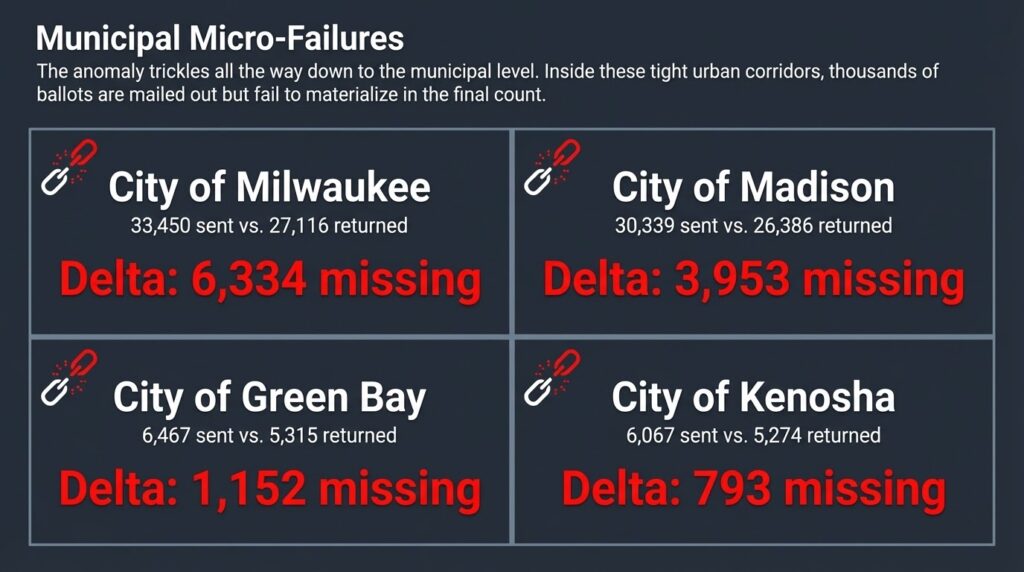
A statewide total of nearly 60,000 can feel distant. But “6,334 missing” in the City of Milwaukee or “3,953 missing” in Madison feels more immediate.
Prove me wrong that absentee vulnerability is not a vague statewide fog. It appears in specific municipalities, with identifiable deltas between sent and returned ballots.
That invites more pointed local questions in bigger cities: what housing patterns, election procedures, mail handling realities, or voter behaviors are driving these gaps?
But what about localizing accountability for every county in the state? Once the issue is reduced to a city-by-city delta, it becomes harder for officials or the public to treat it as a purely abstract statewide phenomenon.
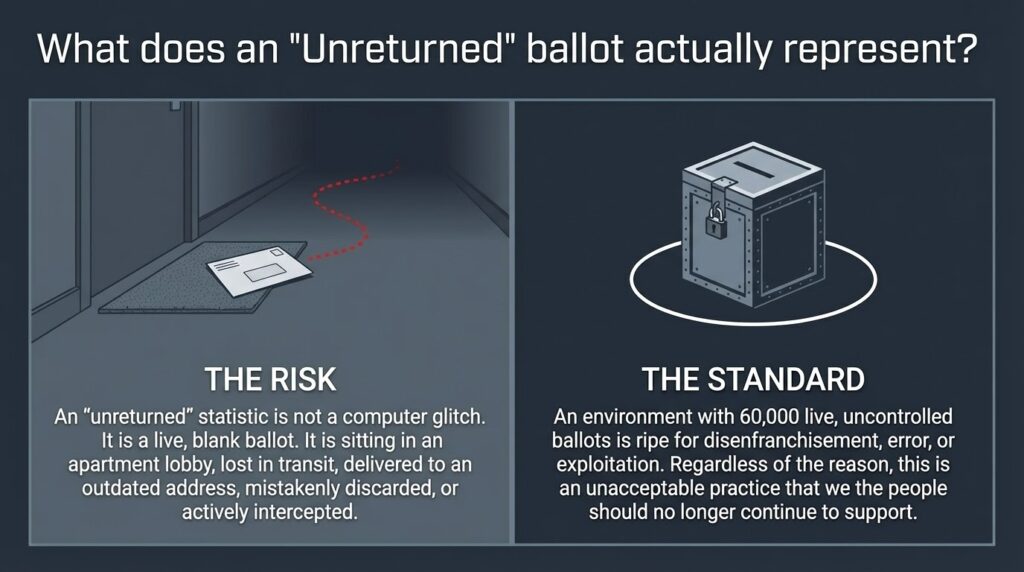
I am NOT saying every unreturned ballot was intercepted. Listen, an unreturned ballot represents uncertainty: not proven criminality, but unresolved ballot custody.
It is now time to force a different mental model in the minds of Wisconsin Voters. I will asks voters to stop thinking of an unreturned ballot as a harmless data artifact and start thinking of it as a live ballot that exited controlled handling and never completed a traceable return.
This is a powerful necessary reframing. In security terms, uncertainty is not neutral. Uncertainty is itself a weakness.
Think like a magician!
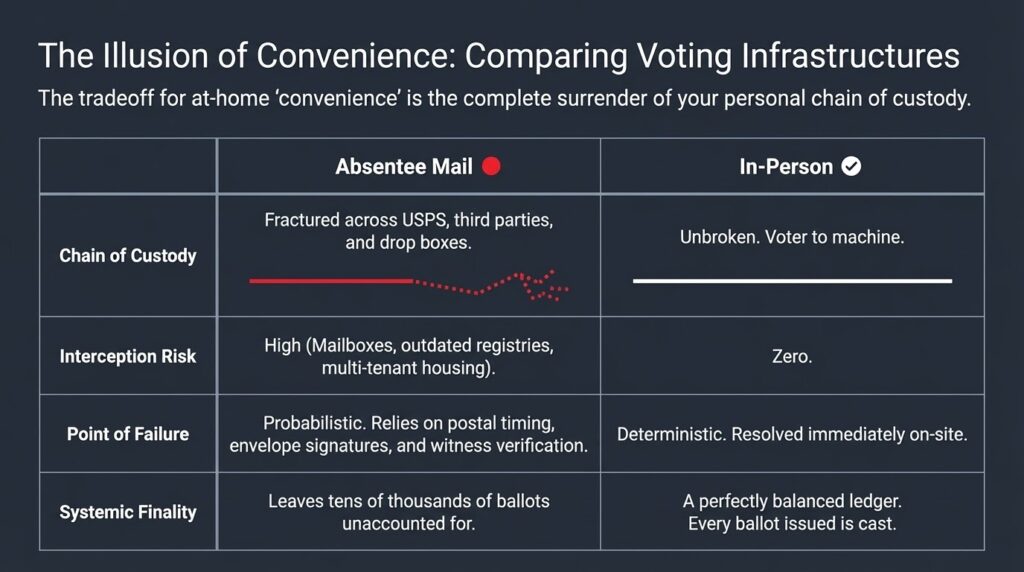
Now I ask; whether one voting method is structurally more vulnerable than another.
The answer is unequivocal: yes.
I see absentee mail as probabilistic, fragmented, and dependent on multiple external factors.
By contrast, in-person voting is framed as deterministic and immediate. That is not merely a rhetorical contrast; it is the policy argument taking shape.
The key phrase here is “illusion of convenience.” suggesting that what voters gain in personal comfort, they surrender in custody and certainty.
That is the philosophical spine of the whole report: convenience is not free. It is purchased by dispersing control.
Whether one agrees fully or not, we need to turn the argument from “mail voting is easy” into “easy for whom, and at what cost?”
The risk is greater than the reward! Please. Prove me wrong.
Let me be clear I am not anti-absentee. It has a place and a time, and certainly SHOULD NOT RELY ON A MAIL BOX.
This is not about making voting harder. Or ignoring the God for bided fears and scenarios of actual election day.
It is about preserving ballot control.
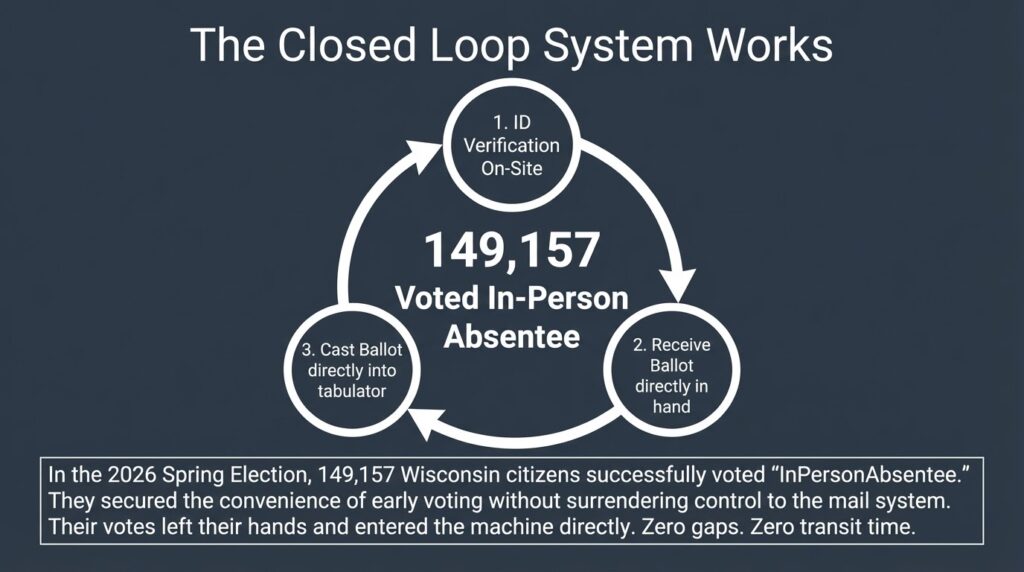
In-person absentee voting numbers can be offered as proof that convenience and chain of custody do not have to be mutually exclusive. For those who fear the “What if’s” of actually voting on elections day.
Instead of telling every voter to simply wait until Election Day no matter what (even though that is the best of the best option in my strong opinion), In person absentee at least offers a system that still allows flexibility while reducing the custody gap created by the mail stream.
Regardless we must embrace the concept of a closed loop the best we can.
Once again I will say clearly, I am not really arguing about ideology. I’ll make the argument about process engineering.
A closed loop is easier to defend, easier to explain, and harder to compromise.
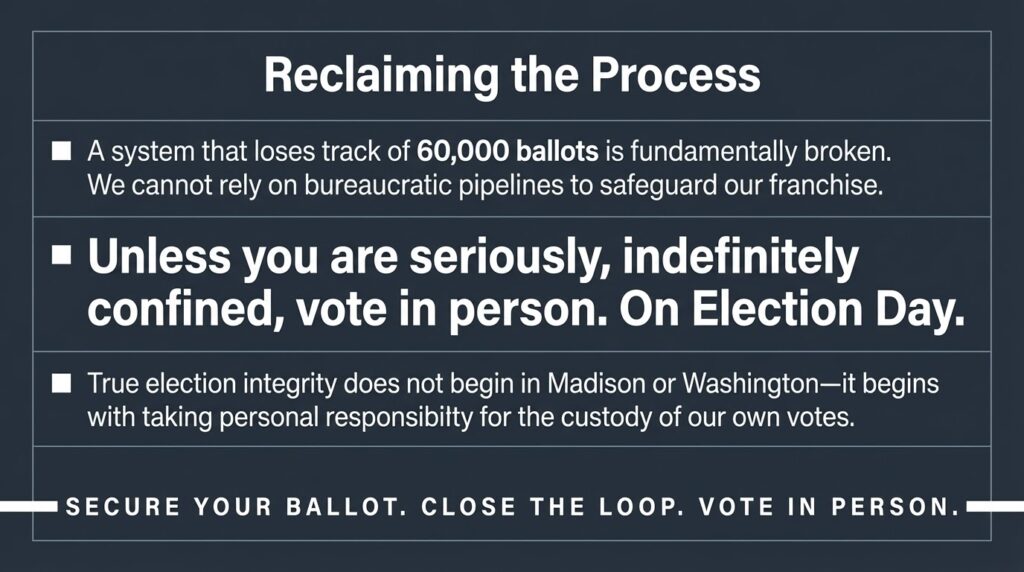
If chain of custody matters, then in-person voting is the cleanest, strongest, and most defensible standard.
My advocacy is built on analysis. I am using the stater statistics to arrive at a civic command:
Vote in person.
That is our personal responsibility.
That shifts the burden from institutions to citizens themselves. The message is that election integrity does not begin only with state officials, judges, or legislatures. It begins when individual voters choose the most secure available methods.
Understanding that civic duty should be active rather than passive, or that self-government requires more than opinions; it requires disciplined participation….Just makes common sense. Wouldn’t you agree?
All source data for my report can be found and downloaded here: reference files from 3/14 – 4/9/2026 https://elections.wi.gov/resources/statistics/absentee-ballot-report-april-7-2026-spring-election
TONIGHT 8 PM CENTRAL: LISTEN LIVE
Tonight at 8 PM Central, join AJ “The Ripon Rabbit” for a full Ripon Rabbit Hole LIVE exposé on The 60,000 Ballot Gap—an in-depth, breakdown of Wisconsin’s unreturned absentee ballots, where the numbers cluster, what they may mean, and why the case for returning to in-person voting is stronger than ever.
This will not be a surface-level recap or a watered-down talking-points show. AJ will dig deeper into the data, the geography, the systemic weaknesses, and the bigger questions too many are afraid to ask.
Tune in live at RiponRabbitHole.com, and be part of the conversation as we pull back the curtain on one of the most troubling election integrity stories in Wisconsin.