

 The Ripon Rabbit
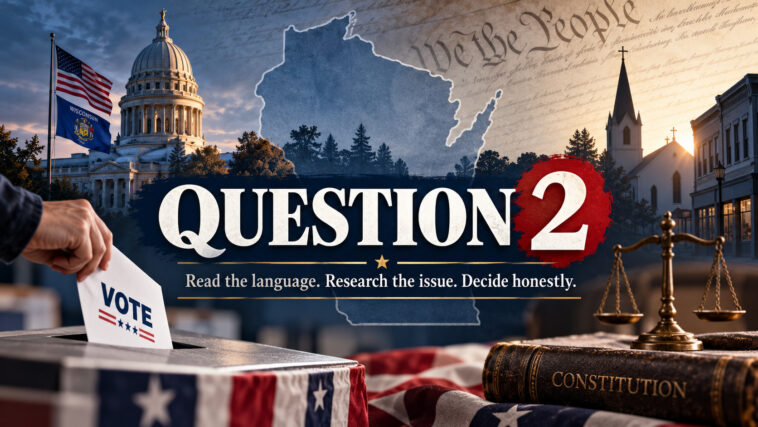
Wisconsin’s proposed constitutional amendment raises a question far bigger than churches, mosques, or COVID-19. It raises questions about government authority, equal treatment, and the unintended consequences of creating special constitutional protections.
Recently on this network, both On Air and in print, in favor opinions for Wisconsin conservatives voting yes on all three referendum questions has been shared.
At the time, I will admit for the most part this made sense. However, at the time of this writing, I will tell you.
I was wrong.
Some may ask why? And the only convictions I have to share stem from a shift in the way I feel now after attending Ron Branstner’s Saturday Workshop event. (if you missed this, you are encouraged to replay the on demand) After observing this presentation for all 3 hours I will tell you, Ron shared far more facts than opinions. In addition, personal conversations in this Sundays Two or More Gatherings has caused me to further reflect.
After weighing Ron’s presentation heavy on my heart, hearing personal testimony from other audience members feeling the same conviction and after rereading Question 2, I now choose to share my opinion as well.
Religious freedom is not something the government gives us. It is a right protected by the United States Constitution and Wisconsin’s own constitution.
The First Amendment of the U.S. Constitution features the Free Exercise Clause and the Establishment Clause. Together, they bar the government from establishing a state religion, favoring one faith over another, or banning a religious group based on its teachings. The government does not maintain an official list of “approved” or “disapproved” religions.
However, the U.S. legal system draws a strict line between beliefs (which are absolutely protected) and actions (which must comply with generally applicable civil and criminal laws). While a religion itself cannot be banned, specific actions or organizational benefits can be restricted, denied, or prosecuted under applicable laws.
The freedom to believe, worship, and practice religion without unlawful government interference is fundamental to this nation. I strongly support this.
But what happens when an effort to protect one constitutional freedom creates uncertainty about how other laws can be enforced?
That’s a question I believe Wisconsin voters should seriously examine before deciding Question 2 on November 3.
The proposed amendment would prohibit state and local governments from ordering places of worship closed or forbidding gatherings inside them in response to a declared emergency, including a public-health emergency.
Sounds reasonable enough, doesn’t it?
After all, nobody wants to see government officials arbitrarily shutting down churches, mosques (*note this term is not in the language of the proposed amendment), synagogues, or other religious institutions.
But there’s something buried beneath the appealing promise of religious freedom that deserves considerably more attention.
What exactly qualifies as a place of worship?
And perhaps more importantly, who gets to decide?
THE MINNESOTA POST OFFICE QUESTION
A video circulating on X purports to show a Minnesota post office that also functions as a mosque.
All Hell Broke Loose at a USPS inside a Mosque in Minnesota. @MNFraudFinder https://t.co/n0x0jkhalX
— Zak X (@GDaddyzs) October 25, 2026
The precise circumstances surrounding that video have not been independently established, but the situation it describes introduces a fascinating constitutional dilemma. Nevertheless the video above is disturbing to say the least.
Suppose a government building also serves as a place of religious worship.
Or a storefront operates as both a business and a prayer center.
What about a warehouse that hosts religious gatherings on weekends? A private residence used for regular worship? A community center shared by secular organizations and religious congregations?
Under Wisconsin’s proposed amendment, would any of these locations qualify for special protection against emergency closure?
And would the constitutional protection apply only to religious gatherings, or could it complicate efforts to regulate other activities occurring in the same building?
These questions are not attacks on Islam, Christianity, Judaism, or any other religion.
They apply equally to all of them.
In fact, that’s precisely the point.
If the government creates special constitutional protections for places of worship, it needs to explain what makes a location a place of worship in the first place.
A Wisconsin constitutional amendment would not override federal postal rules, and merely conducting religious services in a building would not automatically exempt every activity there from regulation.
Nevertheless, the question of mixed-use properties exposes an important area of legal uncertainty.
A CONSTITUTIONAL PROTECTION WITHOUT A CLEAR DEFINITION
Here’s where Question 2 becomes particularly interesting.
The proposed amendment does not provide a new definition of “a place of worship”.
That means questions about which properties qualify, and how the protection applies to buildings with multiple uses, may ultimately be resolved by the courts.
Think about the possibilities.
A restaurant allows a religious congregation to use its dining room on Sundays.
A retail business rents part of its building to a religious organization.
A warehouse becomes the regular gathering place for a congregation.
A private home hosts weekly worship services.
Under ordinary circumstances, those arrangements might raise few if any problems.
But during a declared emergency, when officials impose temporary restrictions on certain public gatherings, the distinction could suddenly become extraordinarily important.
Could officials prohibit gatherings in a convention center while being constitutionally barred from prohibiting gatherings in a comparable building used for worship?
Could a business challenge an emergency closure order because part of its property serves a religious purpose?
Would judges have to determine whether particular gatherings were genuinely religious?
And after hearing Ron’s presentation in full, isn’t that last question particularly troubling?
We would be asking government officials and courts to make distinctions about religious activity that constitutional protections are supposed to prevent government from arbitrarily making.
To be clear, these are possible legal disputes, not automatic loopholes established by the proposed amendment.
But constitutional amendments should be evaluated partly by the questions they leave unanswered.
WE ALREADY HAVE RELIGIOUS FREEDOM
The First Amendment protects the free exercise of religion.
Article I, Section 18 of the Wisconsin Constitution also protects religious liberty and freedom of conscience.
These protections exist today. Now.
They do not simply vanish when a governor declares an emergency.
Government actions that unlawfully discriminate against religious exercise can and have been successfully challenged in court.
Question 2 would go a significant step further.
Rather than relying on existing constitutional protections and judicial review, it would create an express constitutional prohibition against emergency closures and bans on gatherings in places of worship.
According to an analysis published by the University of Wisconsin Law School, Wisconsin’s proposal would offer places of worship broader protection against emergency closures than many other essential establishments.
That raises a legitimate question.
Should one category of gathering receive constitutional protection against closure when comparable gatherings do not?
COVID-19 EXPOSED GOVERNMENT OVERREACH. BUT DID WE LEARN THE RIGHT LESSON?
The COVID-19 pandemic revealed serious disagreements about the limits of emergency government authority.
Religious gatherings WERE restricted. Businesses WERE closed. Families WERE separated. People questioned decisions made by governors, public-health officials, and unelected administrators.
Some restrictions were challenged successfully, and the constitutional treatment of religious gatherings became an important national legal issue.
Those debates deserve continued scrutiny.
But here’s the danger of responding to one emergency with a permanent constitutional amendment.
We may be writing constitutional rules based on the circumstances of yesterday without adequately considering the emergencies of tomorrow.
We know what happens during an unfamiliar infectious-disease outbreak.
What happens when a dangerous environmental condition requires evacuating an entire neighborhood?
What happens when religious and commercial activities occupy the same facility?
The amendment specifically addresses closures imposed in response to emergencies. It does not necessarily prohibit ordinary building-safety enforcement or every evacuation measure.
Yet questions about the boundary between protected worship and permissible emergency action remain.
The Constitution is not supposed to be rewritten every time Americans disagree with how a particular administration exercised its authority.
It is supposed to establish principles that endure long after that administration is gone.
PROTECTING RELIGION OR CREATING A SPECIAL CLASS?
Here’s another uncomfortable question.
If a Christian church, Islamic mosque, Jewish synagogue, and secular community organization all occupy comparable buildings and host comparable gatherings, why would emergency restrictions depend on the religious character of the gathering?
Supporters of Question 2 argue that worship is a constitutionally protected activity and deserves stronger safeguards.
That is a serious argument.
But opponents may raise a different constitutional concern: Should emergency law distinguish between otherwise comparable activities because one organization is religious and another is not?
Wisconsin’s constitution already prohibits legal preferences among religious establishments and modes of worship.
Question 2 would not expressly favor one faith over another.
However, it would create an additional protection for “places of worship” that secular organizations would not necessarily receive.
That distinction deserves a much more thoughtful debate than simply asking whether people believe in religious freedom.
Of course we believe in religious freedom.
The controversy is over the scope of this particular amendment.
THE DANGER OF GOOD INTENTIONS AND UNINTENDED CONSEQUENCES
There is an important difference between protecting a right and creating an exemption from government authority.
One places constitutional limits on government.
The other may remove particular emergency-response tools altogether.
Both can be defended in principle, but they are not the same thing.
Question 2 would permanently alter Wisconsin’s constitution.
Once adopted, its “meaning” would only then be developed through legal interpretation, court challenges, and future disputes involving circumstances today’s voters may never have imagined.
Unlike ordinary legislation, a constitutional amendment cannot easily be rewritten when unintended consequences emerge.
That is precisely why the language matters.
The Minnesota mixed-use building scenario offers a useful thought experiment.
It asks whether the proposed amendment has been written with enough precision to distinguish religious freedom from the other activities occurring within a particular property.
And it challenges us to consider whether a building’s religious use should change the government’s authority over otherwise comparable gatherings.
These are questions that deserve answers before constitutional language becomes permanent law.
RELIGIOUS LIBERTY SHOULD NOT REQUIRE CONSTITUTIONAL CONFUSION
None of this diminishes the importance of religious freedom.
Quite the opposite.
The right to worship is too important to reduce to a politically appealing ballot description.
Religious communities should be protected against discriminatory government actions.
Emergency declarations should never provide officials with unchecked authority.
Public-health measures should remain subject to constitutional limits, judicial review, and meaningful accountability.
But the challenge of protecting religious freedom cannot be separated from the equally serious responsibility to write clear constitutional law.
Question 2 presents voters with a significant choice about the relationship between religious institutions and emergency authority.
Some who say YES seek certainty that religious gatherings cannot again be prohibited in response to a declared emergency.
Some who say NO question whether the proposed language achieves that protection without creating unnecessary ambiguity and unequal treatment.
Both concerns should be understood before voting.
BEFORE WE CHANGE THE CONSTITUTION, LET’S ANSWER ONE SIMPLE QUESTION
If a post office, warehouse, storefront, restaurant, or private home can also serve as a place of worship, exactly where does the constitutional protection begin and end?
Does it protect the worship?
Does it protect the gathering?
Does it protect the building?
And who makes that determination?
Those questions are NOT answered explicitly in the proposed language.
Wisconsin voters deserve a serious discussion of those distinctions before adopting a permanent constitutional rule.
Because protecting liberty means more than responding to the last government overreach.
It means writing constitutional safeguards that remain clear, consistent, honest, open, transparent and workable during the next crisis.
A constitutional amendment should resolve uncertainty, not leave future generations to untangle its meaning.
And when we’re dealing with the Wisconsin Constitution, those are questions worth asking before November 3.
Let me be absolutely clear: I am in no way telling you, the voter, how to vote. I’m simply sharing my observations, concerns, and personal conviction as someone looking in from the outside.
Advocating for a renewed conservative Wisconsin affects me too. My family roots are firmly planted there. Of course I want a better Wisconsin for my elderly parents, for my sisters and for nephews and nieces, and for my friends. But the decisions we make today will affect our children’s, children.
Ultimately, this decision belongs to you and you alone. My hope is that every Wisconsin voter takes the time to read the actual language of Question 2, research its implications, consider the arguments on both sides, and weigh the decision honestly in their own heart and conscience.
Don’t cast your vote simply because the loudest voices, the majority of your friends, your political party, or an overwhelming chorus of opinions tells you what to believe. Popular opinion is not always informed opinion, and good intentions do not always guarantee good outcomes.
Think independently. Ask difficult questions. Challenge even the opinions you agree with. And when you step into that voting booth, make sure the decision you cast is truly your own.
After all, that is what freedom is all about.
That just makes common sense. Wouldn’t you agree?
Ripon Rabbit Hole — Question Everything. Examine the Evidence. Seek the Truth.
Research and references:
- University of Wisconsin Law School, Wisconsin’s Proposed Constitutional Amendment on Emergency Closures of Places of Worship, October 2, 2026.
- Wisconsin Constitution, Article I, Section 18.
- Wisconsin’s 2026 constitutional amendment ballot language.
- Minnesota social-media video shared for discussion; its specific factual claims have not been independently verified.