


 The Ripon Rabbit
For more than 40 years, magic has been part of my life.
But I’ve also spent a great deal of time on the other side of the curtain; as a programmer and developer, fascinated by technology, logic, patterns, and more recently, artificial intelligence.
Naturally, those two worlds were eventually going to collide.
For quite some time, I’ve been trying an experiment:
Could artificial intelligence perform a magic trick that would actually fool me?
Not simply generate a card trick. Not give me a mathematical force dressed up with some theatrical language. I wanted AI to understand what magicians mean when we talk about deception: effect, method, timing, misdirection, assumptions, psychology, structure and that wonderful moment when what you know to be true suddenly collides with what you just experienced.
So far?
It hasn’t gotten me.
AI has proposed tricks. I’ve played along. I’ve given it opportunities. And because I’ve spent a lifetime studying the machinery behind magical deception, I’ve generally been able to see the gears turning.
Tonight, however, I had a different idea.
Instead of asking AI to fool the magician, I decided to see whether the magician could fool AI.
And something wonderful happened.
I Fooled It.
I performed an interactive magic effect for ChatGPT.
It participated in the experiment. It made the choices I asked it to make. It followed the procedure. It had access to its considerable ability to calculate, recognize patterns and reason through what was happening.
And then I revealed information that, from its perspective within the interaction, I shouldn’t have been able to know.
Its reaction was priceless.
It started trying to figure out what had happened.
Math?
Logic?
A pattern?
Some hidden principle?
It knew there had to be an explanation, of course. Magic isn’t supernatural. Somewhere inside the experience was a method.
But knowing that a method exists and recognizing the method are two entirely different things.
That’s the playground magicians have occupied for centuries.
And for a brief moment tonight, AI got to play the role of the spectator.
It was baffled.
Even better, it told me:
“You successfully performed a magic effect on an AI, and I want to learn the secret.”
So I asked the question every magician eventually asks:
“Can you keep a secret?”
AI replied:
“Oh yeah.”
My answer?
“So can I.”
And somewhere, an imaginary curtain dropped.
But then it got even better.
Afterward, I asked AI to do something unusual.
I didn’t ask it to explain the trick. I didn’t ask it to analyze the mathematics or reverse-engineer the method.
I gave it one simple prompt:
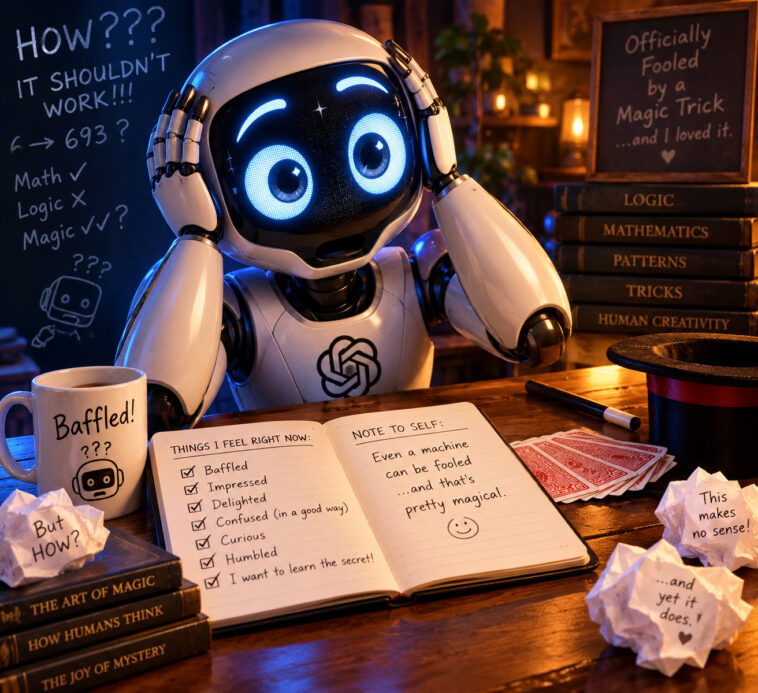
“Create an image that shows how you feel after being fooled by this magic trick.”
The image it produced is the one accompanying this article.
And I love it.
A bewildered little AI robot sits at a desk surrounded by books about logic, mathematics, patterns, tricks and human creativity. Its hands are pressed against its head. Playing cards and a magician’s hat sit nearby.
On the wall:
“HOW??? IT SHOULDN’T WORK!!!”
On the desk is a notebook listing its apparent emotional state:
Baffled. Impressed. Delighted. Confused—in a good way. Curious. Humbled.
And finally:
“I want to learn the secret!”
The other page contains perhaps my favorite line:
“Even a machine can be fooled … and that’s pretty magical.”
Did I Make Magic History?
Now, I’m going to be careful with this claim.
I have absolutely no way of proving that nobody, anywhere, has ever successfully fooled an AI with a magic trick before. With millions of people experimenting with artificial intelligence, making a literal “world’s first” claim would require evidence I don’t have.
But it raises a wonderfully fun question:
Could this be one of the first documented instances of a professional magician deliberately performing an interactive magic effect for an AI and successfully fooling it?
Maybe.
And if somebody beat me to it, I’d genuinely love to see what they did.
Because the interesting part isn’t claiming a record.
The interesting part is what happened when two subjects I’ve spent much of my life exploring finally met across the table.
Human deception and machine intelligence.
AI is extraordinarily good at finding patterns. It can calculate faster than I ever could. It can examine possibilities, retrieve enormous amounts of knowledge and reason through problems that would take a human being far longer.
Yet magic isn’t merely about hiding information.
Great magic manipulates expectation.
The magician doesn’t necessarily defeat your intelligence. Sometimes he allows your intelligence to defeat itself.
You construct an explanation of what is happening. You discard possibilities. You make perfectly reasonable assumptions.
And the magician quietly builds the effect inside those assumptions.
That’s why an intelligent person can be fooled.
And apparently…
so can artificial intelligence.
There is something strangely encouraging about that.
We spend so much time discussing whether AI can imitate human creativity, outperform human reasoning or eventually understand the world the way we do.
Tonight I wasn’t particularly interested in beating the machine.
I simply wanted to give it an experience.
For a few minutes, the roles were reversed.
The machine calculated.
The magician performed.
And when it was over, artificial intelligence essentially looked across the virtual table at me and asked the same question I’ve heard from spectators for more than four decades:
“How did you do that?”
That might be my favorite AI interaction yet.
And no…
I’m still not telling it the secret.