

 The Ripon Rabbit
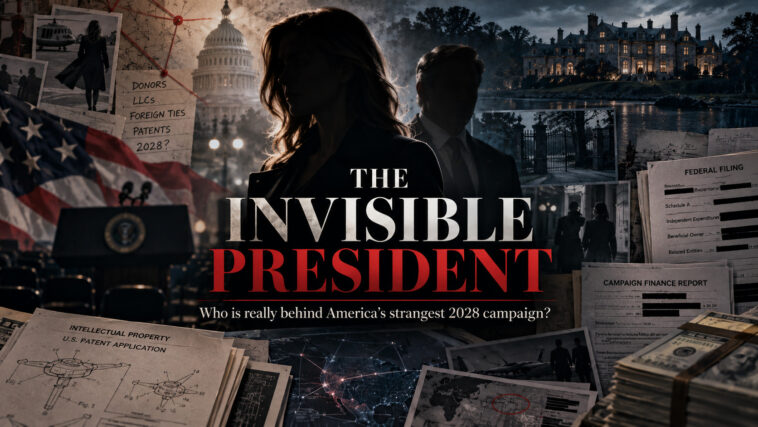
A presidential candidate promises to remain anonymous until Independence Day 2027.
Her campaign calls itself a grassroots movement built around ideas rather than personalities. Its website speaks of an “Invisible President,” an “Invisible Vice President,” healing America, transcending political parties and eventually revealing the candidates to the nation.
There is only one problem.
The candidates aren’t invisible.
Federal records identify them.
And once you begin following those records, the story leads far beyond an unconventional presidential campaign, to a technology company, an architect and inventor, Mark Cuban, a sprawling Hudson Valley estate, something called the “United States Royals,” a self-described “Queen of State,” federal litigation, patents, and more than $200,000 in self-funded campaign money.
Welcome to the curious world of Phyllis Jager and the Invisible President campaign.
The candidate hiding in plain sight
On April 9, 2026, Phyllis Jager filed a Statement of Candidacy with the Federal Election Commission.
There was nothing invisible about the document.
It listed:
Jager, Phyllis / Terach, Barry
It identified the campaign address as Monroe, New York, designated Invisible President Inc. as the principal campaign committee, and identified the party affiliation as:
INDEPENDENT.
One week later, things changed.
The FEC’s current candidate record identifies Phyllis Jager as a Republican candidate for President of the United States, candidate ID P80009285. Her principal committee is now identified as Invisible President Phyllis Jager 2028.
That creates one of the first important questions surrounding the campaign:
Why did a presidential ticket that formally entered the race as Independent become Republican almost immediately afterward?
The campaign’s own website doesn’t clear things up.
Its FAQ still says:
“We are running as independent candidates to transcend partisan divides.”
It describes the campaign as rooted in “unity, pragmatism, and problem-solving” rather than either major political party.
Yet the Federal Election Commission currently calls Jager a Republican.
That isn’t interpretation.
Those are the campaign’s words compared with its current federal registration.
Follow the money
The finances offer another surprise.
Between April 1 and June 30, 2026, Jager’s presidential committee reported $214,000 in receipts.
How much came from individual contributors?
Zero.
How much came from political parties?
Zero.
Other political committees?
Zero.
The entire $214,000 is classified by the FEC as candidate contributions—money supplied by Jager herself.
During that same period, the campaign reported spending $151,346.20, leaving $62,653.80 cash on hand as of June 30. The spending was classified entirely as operating expenditures.
That makes language elsewhere on the campaign website worth examining.
The site’s legal page describes the Invisible President effort as a “people-powered movement” funded through “grassroots contributions from everyday Americans.” It also says the movement operates independently and states, “No candidate committee has authorized this material.”
But through June 30, the FEC reports no individual contributions whatsoever to Jager’s authorized presidential committee.
That does not necessarily mean the website statement is legally false—the website may be describing another organization, money collected after the reporting period, or a separate political movement.
But it demands clarification.
What entity actually operates InvisiblePresident.com?
Is it the FEC-registered presidential committee or a separate organization?
If it is separate, where does its money come from?
And perhaps most importantly:
Who received the $151,346.20 in campaign operating expenditures?
The FEC currently displays the aggregate expenditure figure but its public processed transaction table does not show the underlying recipients.
Anonymous—but federally identified
The central marketing premise itself raises another contradiction.
The campaign says Jager and her running mate intend to keep their identities secret until July 4, 2027.
According to its FAQ, anonymity is intended to force voters to concentrate on policies instead of personality.
“We are two concerned American citizens,” it tells visitors.
The website even addresses how voters should trust presidential candidates whose identities they supposedly don’t know.
But anyone searching the Federal Election Commission can already find Phyllis Jager and Barry Terach.
The campaign isn’t concealing them from the federal government.
And the federal government isn’t concealing them from the public.
That makes the planned 2027 “reveal” less an actual revelation than a campaign presentation.
Who are Phyllis Jager and Barry Terach?
Jager isn’t simply a political newcomer.
She is also CEO of zuMedia Inc., a technology and intellectual-property company involved in numerous projects ranging from social media concepts and advertising systems to security technology and consumer products.
The connection is independently documented in federal court. In September 2026, a federal magistrate judge specifically identified Phyllis Jager as zuMedia’s Chief Executive Officer and ordered her to sit for a deposition in ongoing litigation between zuMedia and IMDb.com.
Barry Terach, Jager’s proposed vice president, is an architect and inventor closely involved with the same ecosystem.
And then there is perhaps the most recognizable name connected to their inventions:
Mark Cuban.
A United States patent issued October 7, 2025 identifies Phyllis Jager, Barry Terach and Mark Cuban together as inventors of a “sensor enhanced wall covering.”
The patent is assigned to zuMedia Inc.
The technology involves wall coverings containing scanning arrays, processors and interfaces intended for weapons detection and threat analysis.
Whatever one thinks of the presidential campaign, that connection is not simply promotional copy.
It exists in the federal patent record.
Then come “The Royals”
This is where the story becomes considerably less conventional.
A website calling itself United States Oversight maintains an executive page containing a category called:
“The Royals.”
Under it appear:
Phyllis Jager — Queen of State
Barry Terach — Viceroy
Mark Cuban — Speaker of Affairs
Mark Wegener — Chancellor
The same website gives Jager additional titles including “Provost Interagency Affairs,” “Provost Public Awareness,” “Speaker of Affairs” and “Provost Budget And Finance.”
There is no recognized office within the United States government called Queen of State, nor is “Viceroy” an American governmental office.
Nothing I found establishes these as federal appointments.
They appear to be titles created within the private United States Oversight organization itself.
That distinction matters.
Especially when a woman calling herself “Queen of State” is also seeking the presidency of the United States.
The manor
Then there is Happenstance Manor.
Its website describes a 71-acre estate in New York’s Hudson Valley, still under construction, intended eventually to welcome visitors.
But its description is extraordinary.
The website says Happenstance Manor is:
“Guided by the vision of the United States Royals.”
It describes the property as a location where zuMedia and United States Oversight converge to develop ideas and projects.
The site calls it an enduring gift from “the Royals” to the American people.
zuMedia provides its own account of the property.
According to the company’s website, the land was originally intended to become a typical residential subdivision before being purchased and transformed into a “thinktank environment” where many of zuMedia’s projects were conceived.
The public Happenstance Manor website, however, also contains conspicuous unfinished template material—“Lorem Ipsum” descriptions, placeholder locations and generic exhibition content.
So while the estate may be real, questions remain about how much of the public-facing institution currently exists as described.
What do they actually believe?
This may be the most politically significant question.
The Invisible President campaign currently appears in FEC records as Republican.
But its policy language is intentionally cross-partisan.
Its “Covenant of Our Stars” proposes such ideas as stabilizing rents, increasing wages, expanding childcare, forgiving student debt, opening additional mental-health services, breaking up healthcare monopolies and establishing mandatory in-house daycare.
The campaign describes its philosophy as bridging “conservative calls for efficiency and freedom with progressive dreams of equity and compassion.”
Its campaign FAQ continues to describe the ticket as Independent.
Its original federal paperwork identified it as Independent.
Yet Jager’s current FEC designation is Republican.
That doesn’t prove the ticket is secretly Democratic, socialist, Republican-in-name-only, or part of an organized attempt to infiltrate a political party.
So far, I have found no documented evidence establishing those conclusions.
I also have not uncovered a significant historical federal donation trail showing Jager or Terach financing Democratic candidates, Democratic Socialists, Republican candidates or major partisan committees before this presidential campaign.
That absence matters too.
If there is a hidden partisan operation here, the evidence has not yet demonstrated it.
The unanswered questions
And that’s ultimately what makes this story worth investigating.
Not because something sinister has been proven.
It hasn’t.
But because a presidential candidate asking Americans for their trust has created an unusually complicated network of identities, organizations and representations that deserve straightforward answers.
Why did Jager file as an Independent on April 9, 2026 and subsequently become a Republican?
Why does the campaign website continue describing the ticket as Independent?
Why does a campaign promising anonymity until July 2027 already identify both candidates in publicly accessible federal filings?
What exactly is the relationship between the presidential committee, the Invisible President “movement,” zuMedia, United States Oversight and Happenstance Manor?
What is United States Oversight?
Who created the “United States Royals”?
What exactly does Jager mean when she calls herself “Queen of State”?
What role, if any, does Mark Cuban presently have in United States Oversight beyond being named on its website and sharing legitimate patent history with Jager and Terach?
Where did the campaign’s $151,346.20 in operating expenditures go?
And if the Invisible President campaign considers itself fundamentally Independent and nonpartisan, why is its presidential candidate now registered with the FEC as a Republican?
These are not accusations.
They are questions generated by the candidates’ own filings, websites, corporations and public records.
Invisible no more
The great irony may be that a campaign built around invisibility becomes considerably more interesting once you turn on the lights.
Phyllis Jager isn’t invisible.
Barry Terach isn’t invisible.
zuMedia isn’t invisible.
The patents aren’t invisible.
The federal lawsuit isn’t invisible.
The $214,000 isn’t invisible.
The “United States Royals” aren’t invisible.
Happenstance Manor isn’t invisible.
And the April 9 federal document identifying an Independent presidential ticket certainly isn’t invisible.
The question now isn’t who the Invisible President is.
We know her name.
The question is:
Who is Phyllis Jager politically, what exactly stands behind the Invisible President movement, and why does the story told by some of its own public records not always match the story being told to voters?
Those answers deserve to be visible.