


 The Ripon Rabbit
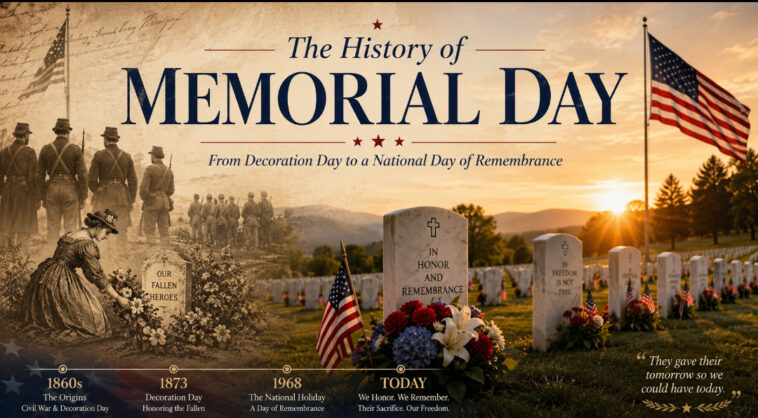
Memorial Day is one of America’s most meaningful holidays, but its meaning is often overshadowed by long weekends, cookouts, lake days, store sales, and the unofficial start of summer.
At its heart, Memorial Day is not about celebration. It is about remembrance.
It is the day America pauses to honor the men and women of the United States Armed Forces who died while serving their country. The holiday grew out of grief, sacrifice, and the painful aftermath of the Civil War, when communities across the country were searching for ways to mourn the dead and heal a divided nation.
The Civil War Roots of Memorial Day
The roots of Memorial Day go back to the years immediately after the Civil War. That war claimed an enormous number of American lives. The National Archives notes that more than 620,000 military deaths occurred during the Civil War, roughly 2 percent of the population at the time. In the wake of such loss, towns, families, veterans, churches, and civic groups began holding local ceremonies to honor those who had died.
These early observances often involved visiting cemeteries, placing flowers on graves, singing hymns, offering prayers, and gathering as a community. The holiday was first widely known as Decoration Day because people would decorate the graves of fallen soldiers with flowers, flags, wreaths, and other tributes.
There is no single uncontested birthplace of Memorial Day. Many towns and cities held early remembrance ceremonies, and more than two dozen places have claimed a role in starting the tradition. Waterloo, New York, was officially recognized by the federal government in 1966 as the birthplace of Memorial Day, but historians continue to recognize that the holiday developed through many local acts of remembrance across the country.
Decoration Day Becomes a National Tradition
The moment that helped turn local remembrance into a national tradition came in 1868.
General John A. Logan, commander-in-chief of the Grand Army of the Republic, an organization of Union veterans, issued an order calling for May 30, 1868, to be set aside for decorating the graves of fallen soldiers. His order helped establish Decoration Day as a coordinated national observance rather than only scattered local ceremonies.
May 30 was likely chosen because flowers would be blooming across much of the country, making it a fitting time to decorate graves. On that first major national observance, Americans gathered at cemeteries to honor those who had died in the Civil War.
One of the most famous early ceremonies took place at Arlington National Cemetery. There, flowers were placed on the graves of both Union and Confederate soldiers, symbolizing mourning, sacrifice, and the hope that the nation might begin to heal.
From Civil War Dead to All Fallen Service Members
At first, Decoration Day was mainly focused on those who died in the Civil War. That made sense because the holiday was born directly out of that national tragedy.
But as the United States entered later conflicts, including World War I and World War II, the meaning of the day expanded. It became a time to honor all American military personnel who died in service, not only those from the Civil War.
Over time, the name Memorial Day became more common than Decoration Day. The newer name better reflected the broader purpose of the holiday: not simply decorating graves, but remembering the fallen.
Memorial Day Becomes a Federal Holiday
For many decades, Memorial Day was observed on May 30. That changed with the Uniform Monday Holiday Act, which moved several federal holidays to Mondays in order to create three-day weekends. Memorial Day became a federal holiday observed on the last Monday in May beginning in 1971.
That change made the holiday more convenient for travel and family gatherings, but it also created tension. Some veterans and historians have argued that moving the holiday contributed to the loss of its solemn meaning. Instead of being seen primarily as a day of remembrance, Memorial Day increasingly became associated with the start of summer, shopping sales, vacations, and cookouts.
That does not mean families should not gather or enjoy the weekend. But it does mean the original purpose deserves to be remembered.
Traditions That Still Carry the Meaning
Many Memorial Day traditions still point back to the original spirit of Decoration Day.
Flags are placed on graves. Parades are held in towns across America. Veterans groups conduct ceremonies. Families visit cemeteries. “Taps” is played. Moments of silence are observed. The American flag is traditionally flown at half-staff until noon, then raised to full-staff for the rest of the day.
In 2000, Congress established the National Moment of Remembrance, encouraging Americans to pause at 3:00 p.m. local time on Memorial Day to remember those who died in service to the nation.
These simple acts matter. They help separate Memorial Day from an ordinary long weekend. They remind us that freedom has a cost.
Why Memorial Day Still Matters
Memorial Day is not about glorifying war. It is about remembering people.
It is about the soldier who never came home. The sailor lost at sea. The Marine who gave everything. The airman whose family received a folded flag. The Coast Guardsman who died in service. The names etched into monuments. The stories carried quietly by Gold Star families and surviving brothers and sisters in arms.
It is also a reminder that national memory requires effort. If each generation does not teach the next what Memorial Day means, the day slowly becomes just another Monday off.
So yes, enjoy the weekend. Gather with family. Grill the burgers. Take the boat out. Laugh with friends. Live in the freedom that others defended.
But pause.
Remember.
Say their names when you can.
Visit the graves if you are able.
Teach the children why the flags are there.
Memorial Day began as Decoration Day, a simple act of placing flowers on the graves of the fallen. More than 150 years later, the act remains the same in spirit: a grateful nation stopping long enough to say, we remember, we honor, and we will not forget.