


 The Ripon Rabbit
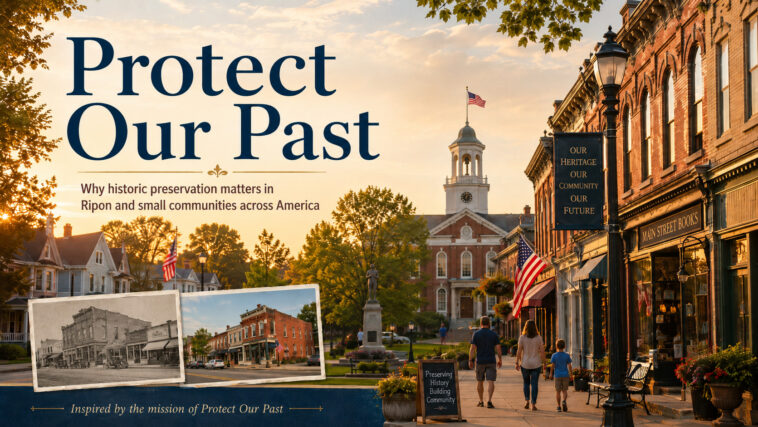
Across America, the soul of a community is often found in the places that still stand.
It is found in the old church on the corner, the brick storefronts along Main Street, the schoolhouse where political path of a party began, the courthouse square, the family homes with hand-built trim, the barns, halls, depots, theaters, and meeting places where ordinary people once made extraordinary history.
That is the spirit behind Protect Our Past, a nonprofit historic preservation organization dedicated to safeguarding Cape Cod’s historic streetscapes, homes, village centers, and community character. The organization describes its mission around education, advocacy, and community action, with a focus on preserving the historic homes and streetscapes that define Cape Cod’s original identity.
But the message of Protect Our Past reaches far beyond Cape Cod.
It speaks to every small community in America — including places like Ripon, Wisconsin, where the past is not some dusty chapter in a textbook, but a living foundation beneath the present.
Ripon understands this better than most. It is a community whose name is tied to one of the most consequential civic movements in American history. Its old buildings, meeting places, neighborhoods, and streets are not merely “old things.” They are evidence. They are witnesses. They remind us that history did not only happen in Washington, D.C., or on famous battlefields. It happened in small towns, around kitchen tables, inside schoolhouses, churches, shops, and local gathering places.
That is why historic preservation matters.
When a historic home or building is torn down, a community does not just lose lumber, plaster, and windows. It loses texture. It loses memory. It loses a piece of the story that made it different from every other place on the map.
Organizations like Protect Our Past help remind us that preservation is not about freezing time. It is about carrying identity forward. Their work encourages preservation, repair, adaptive reuse, and stewardship of the buildings and streetscapes that give a place its character.
For small towns, this is especially important.
A small community cannot compete with a big city by becoming a smaller version of a big city. Its strength is its uniqueness. Its old downtown, its historic homes, its walkable streets, its landmarks, its family stories, its civic memory — these are not obstacles to progress. They are assets.
Historic preservation can also be an economic development tool. The National Park Service says the Federal Historic Preservation Tax Incentives program encourages private investment in rehabilitating and reusing historic buildings and has helped preserve more than 50,000 historic properties since 1976. In 2026, the NPS reported that the program had leveraged $257.8 billion in private investment and produced more than 3.4 million jobs through fiscal year 2024.
That matters on Main Street.
A restored building can become a café, bookstore, office, museum, studio, apartment, visitors center, or gathering place. A preserved downtown can draw tourism, encourage local pride, support small businesses, and give young families a reason to stay. A community that protects its past is often also protecting its future.
The National Trust for Historic Preservation has written that old places give people continuity, identity, and belonging. That may be the simplest and strongest argument of all.
People need roots.
Children need to walk past places where their grandparents once walked. Residents need reminders that their town has endured hard seasons before. Newcomers need a visible story they can join. Visitors need something authentic to discover. Without historic preservation, every place slowly begins to look like every other place.
Ripon, Cape Cod, and countless small communities across America share the same challenge: how do we grow without erasing ourselves?
The answer is not to reject change. The answer is to guide change with respect.
Protect Our Past frames that work through ideas like Respect, Restore, Revive, and Give Back — honoring historic buildings and streetscapes, encouraging repair and reuse, bringing renewed community attention to endangered places, and inviting citizens to support preservation through membership, donations, and volunteer action.
That model could inspire communities everywhere.
Every town should be asking:
What places tell our story?
What buildings are at risk?
What historic homes, churches, schools, cemeteries, theaters, farms, or downtown blocks need attention before it is too late?
Who will speak for the places that cannot speak for themselves?
Because once a historic place is gone, it is gone. A replica may imitate its shape, but it cannot replace the hands that built it, the footsteps that crossed it, or the stories absorbed into its walls.
Protecting our past is not nostalgia. It is stewardship.
It is an act of gratitude toward those who came before us and an act of responsibility toward those who will come after us. It says that our communities are more than real estate. They are memory, sacrifice, craftsmanship, courage, and belonging.
From Cape Cod to Ripon, from old fishing villages to Midwestern Main Streets, from colonial homes to frontier schoolhouses, America’s local history deserves defenders.
The past does not protect itself.
We do.
Watch this short, amazing film put together to protect our past and inspiring story of how we must never forget:
TO LEARN MORE VISIT: www.protectourpast.org