


 The Ripon Rabbit
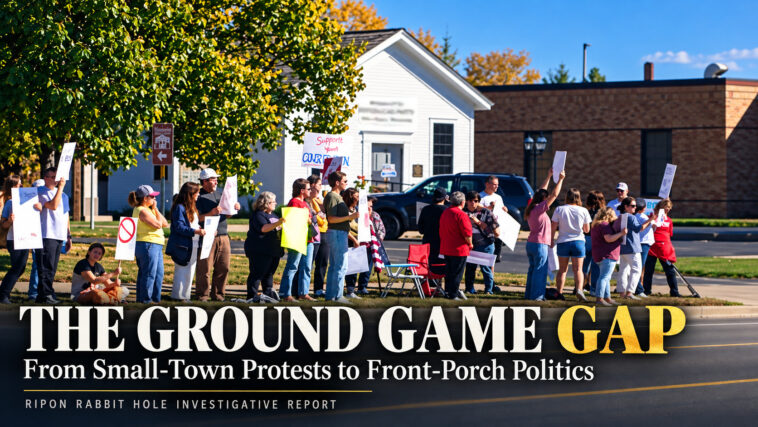
Eyewitness Observations from Marquette County and Ripon Reveal a Growing Grassroots Movement; and Raise Questions About Republican Organizing in Rural Wisconsin
October 20, 2026 | Ripon Rabbit Hole Investigative Report
For months, residents of rural Wisconsin have watched political demonstrations become familiar fixtures in their communities. That social media perceived seemed to start as a joke…
What initially appeared to be routine weekend protests may now deserve a closer look as the November 3 election approaches.

Eyewitness observations from Montello (Marquette County) and Ripon describe a striking contrast in political activity: an energetic, highly visible progressive movement alongside a comparatively quiet Republican presence.
But the more significant story may not be the protests themselves.
It may be what those recurring gatherings have helped build and how that organization is now being directed toward voter participation.

MARQUETTE COUNTY: AN ORGANIZATION IN MOTION
A Marquette County resident who regularly follows both local Democratic and Republican organizations describes months of sustained Democratic activity.
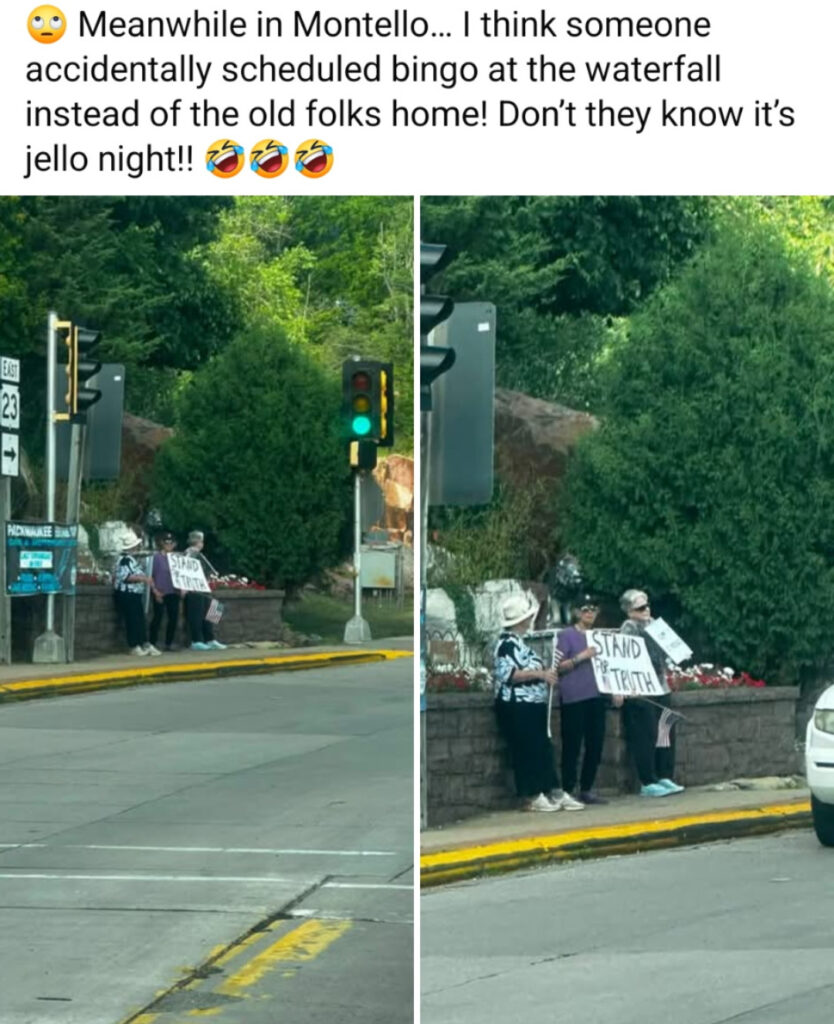
Throughout the summer, demonstrators gathered near the waterfall in Montello for recurring protests, including events associated with the “No Kings” movement.

Over the past three months, the resident reports that Democrats have also established a downtown headquarters, distributed campaign merchandise and yard signs, hosted political candidates, and organized community gatherings.

These events frequently feature food, social interaction, and opportunities for residents to meet candidates.
BUT ALL OF THAT SUDDENLY CHANGED
More recently, the activity has moved directly into residential neighborhoods.
On Saturday, October 17, Democratic volunteers were reportedly knocking on doors, distributing campaign signs, and engaging residents throughout parts of Marquette County.
Meanwhile, the observer describes significantly less visible activity at the waterfall rally point.
A recent Republican spaghetti dinner in the Westfield area reportedly attracted approximately 50 participants, but the resident has observed relatively little comparable public outreach or neighborhood canvassing.
These observations cannot establish the full extent of either party’s campaign operations. They do, however, raise legitimate questions about the differences in visible political organizing.
RIPON: A FAMILIAR PATTERN AT THE LITTLE WHITE SCHOOLHOUSE

Marquette County is not the only place where this pattern has attracted attention.
For approximately the past year, we have witnessed recurring political demonstrations in Ripon, Wisconsin, outside the historic Little White Schoolhouse a landmark associated with the founding of the Republican Party.
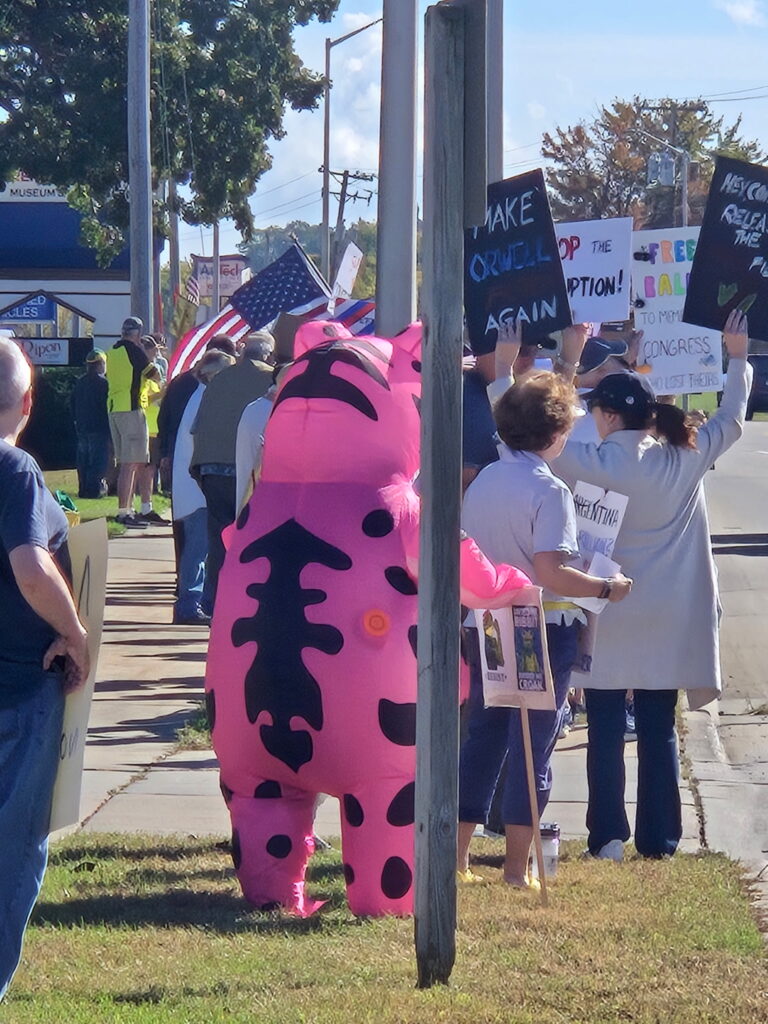
What began as comparatively small gatherings has, by our observation, developed into an increasingly familiar and visible presence.
Week after week, the same location has served as a gathering place for political expression, community involvement, and public demonstrations.
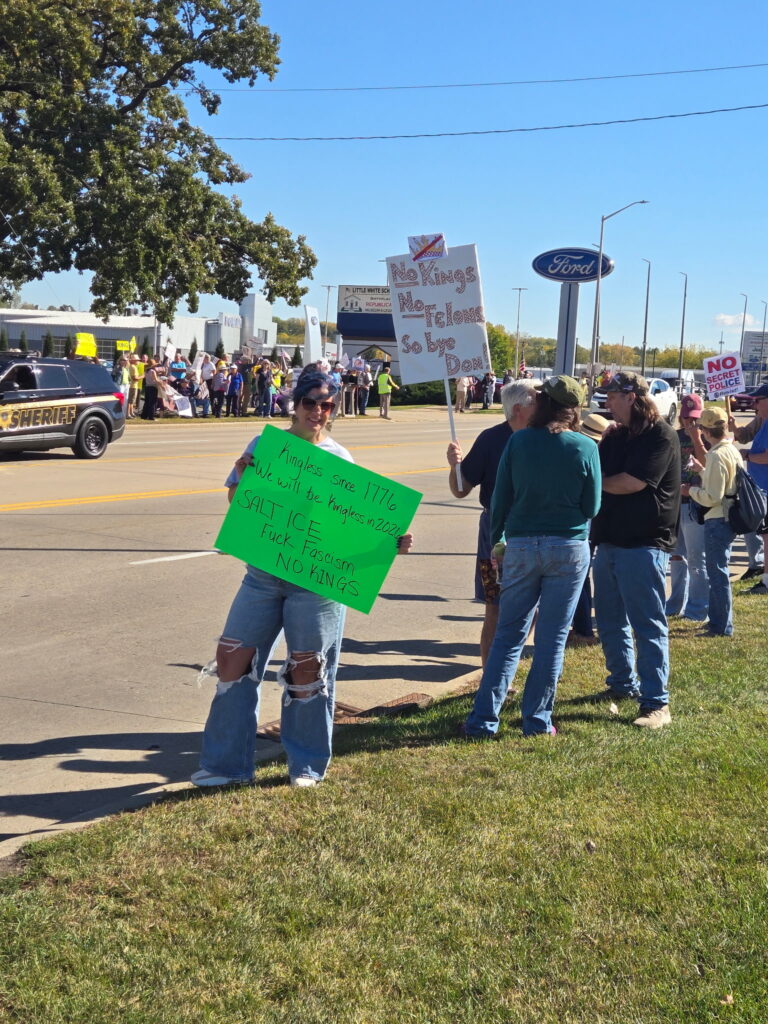
The symbolism is difficult to overlook.
At a landmark associated with Republican political history, demonstrators critical of the current Republican administration have maintained a recurring public presence.
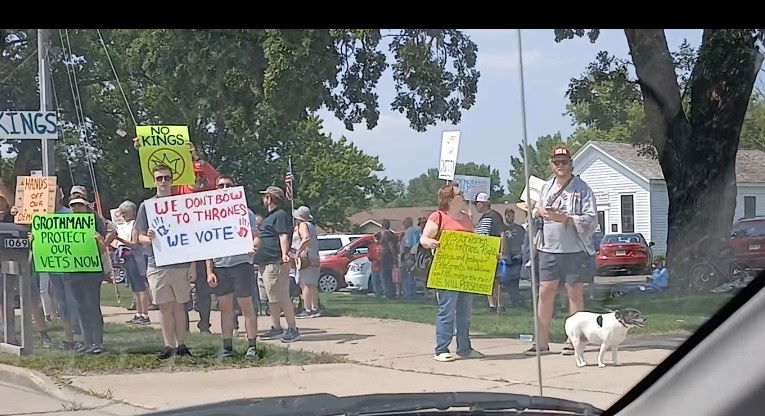
An independently published event announcement confirms that Ripon hosted a “No Kings” demonstration at the Little White Schoolhouse on March 28, 2026. Another event was scheduled there on October 17 under the name “No Kings: Vote Early.”
The second event’s stated emphasis was different from that of a traditional protest.
It was explicitly organized around increasing voter participation ahead of the November election.
That transition; from repeated public gatherings to election-focused organizing is the development worth examining.
THE POWER OF A WEEKLY RITUAL
There is something significant about the routine itself.
A group begins meeting at the same location. Familiar faces return. Relationships develop. Volunteers begin recognizing one another. Communication becomes easier. Participation becomes habitual.
What appears to passing motorists as another weekend demonstration may also be creating a durable community network.
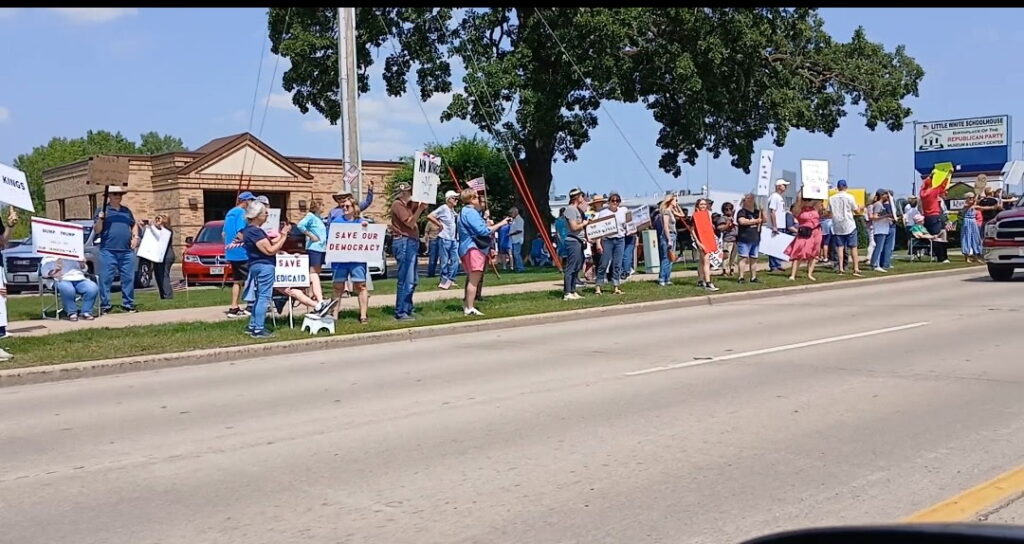
The repetition matters.
Over time, recurring gatherings can build relationships, establish trust among participants, and create opportunities for coordinating future activities.
This does not mean every demonstrator belongs to a political party or participates in election campaigning.
Nor does it establish that every gathering was secretly designed as part of an electoral strategy.
But recurring protests can provide the relationships and organizational infrastructure that make later mobilization easier.
And in the final weeks before an election, those relationships can take on a new purpose.
FROM THE SIDEWALK TO THE FRONT PORCH
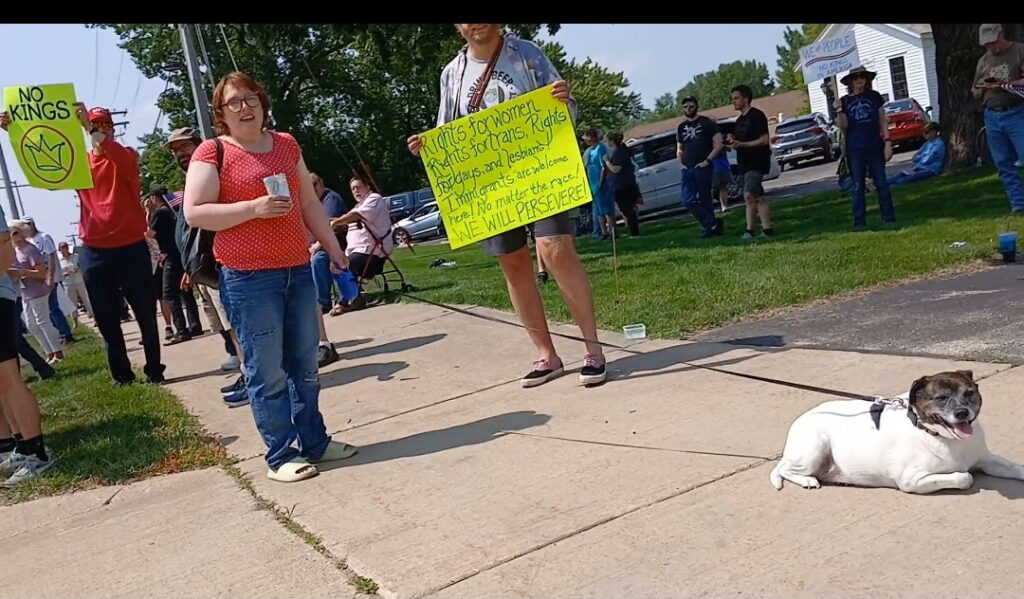
Here is where the local observations connect with a documented national development.
The October 17 “No Kings: Vote Early” initiative was not organized simply as another day of demonstrations.
Organizers openly described a shift toward voter participation.
In Wisconsin, published event listings included canvassing activities in Oshkosh and a rally followed by optional voter canvassing in Lodi.
The Ripon event at the Little White Schoolhouse likewise emphasized early voting.
In other words, the movement was no longer focused exclusively on gathering at public landmarks to express political opposition.
It was also organizing activities intended to reach voters.
The protest site had become one point of political organization. The next point of contact could be a neighborhood doorstep.
This is particularly relevant to the Marquette County eyewitness account, which describes Democratic volunteers knocking on doors and engaging residents just days after months of visible public activity.
The exact organizational relationship between local Democratic campaigns and individual No Kings groups has not been established. The two should not automatically be treated as a single organization.
Nevertheless, the overlap in timing, public engagement, and election-focused activities deserves scrutiny.
A NATIONAL PATTERN, NOT JUST A WISCONSIN STORY
Similar activity has been documented beyond Wisconsin.
The nationwide No Kings movement promoted October 17 as a day of election-related mobilization, encouraging communities to translate public participation into voter engagement.
Some events emphasized early voting. Others incorporated educational activities, gatherings, and outreach.
That offers important context for the observations coming from Ripon and Marquette County.
The broader movement has openly encouraged supporters to move beyond protest participation and engage more directly with the electoral process.
What remains uncertain is how much of that national activity is coordinated through formal Democratic campaign organizations, independent activist groups, or local volunteer networks.
Those distinctions matter.
But one thing is clear: the transition from public demonstrations to election-season voter engagement is not merely an eyewitness impression. It is an openly stated goal of participating organizers.
THE REPUBLICAN QUESTION
Against this backdrop, the apparent lack of comparable Republican visibility in the communities described becomes an important subject for further reporting.
Are Republican organizations conducting door-to-door outreach that simply has not been observed?
Are local candidates relying on established supporters rather than maintaining a highly public campaign presence?
Have Republican volunteer organizations developed their own recurring neighborhood networks?
Or is there a measurable difference in the intensity and frequency of grassroots activity?
A visible rally is not proof of electoral success, just as the absence of a rally is not proof of organizational inactivity.
The answers require evidence: volunteer numbers, canvassing records, candidate schedules, campaign expenditures, and statements from the organizations themselves.
THE SMALL-TOWN NETWORK THAT DESERVES ATTENTION
What makes these observations especially interesting is that they come from smaller Wisconsin communities rather than major metropolitan political centers.
Ripon and Montello are places where recurring gatherings can become familiar to residents over time.

A weekly demonstration is noticed. A new downtown political office draws attention. Neighbors recognize the people distributing signs. Residents remember who came to their doors.
That familiarity may be an important element of grassroots organizing.
The progression deserves examination:
A recurring public gathering. A familiar group of participants. A growing network of relationships. Organized community events. Election-focused outreach.
The individual steps are visible in the reported local activity and published event schedules.
Whether they represent a deliberately coordinated, yearlong national strategy is a separate question that requires additional evidence.
THE TROJAN HORSE
For the past year, many Wisconsin residents may have viewed these gatherings as little more than routine political demonstrations.

The same people. The same signs. The same locations. Another weekend of protests.
But recurring political activity can have effects beyond the message displayed on a sign.
It can build familiarity, establish relationships, recruit volunteers, and create organized networks capable of engaging with the wider community.
Now, as Election Day approaches, some of those networks are openly turning their attention toward voter participation.
In Ripon, the Little White Schoolhouse has been a recurring protest location and an October election-mobilization site.
In Marquette County, an eyewitness describes a Democratic organization actively engaging residents at their doorsteps.
Across the country, the No Kings movement has publicly encouraged a transition from demonstrations toward voter action.
The question is no longer simply who is standing on the sidewalk holding a sign.
It is what those months of gathering have built and what those organizations are doing with that network as Election Day approaches.
That is a story worth investigating, in both political parties and across rural Wisconsin.
THE FINAL WORD: YOUR VOICE. YOUR VOTE. YOUR FUTURE.
Don’t mistake the loudest voices for the will of the people. Don’t let political theater, campaign slogans, or carefully packaged promises replace your own judgment. Question everything. Demand accountability. Look beyond the signs, the rallies, and the rhetoric. Real change doesn’t happen because someone shouts louder on a sidewalk. It happens when informed citizens take responsibility for the future of their communities. On Tuesday, November 3, 2026, Election Day, make your voice count. Know the candidates. Understand what’s at stake. Make a plan to vote and if you’re voting on Election Day, walk through those polling-place doors with confidence and conviction. Your vote is your voice. Your ballot is your power. Your community’s future is too important to leave to someone else. SHOW UP. STAND UP. VOTE.
EDITOR’S NOTE: This report combines firsthand observations from Ripon and a Marquette County eyewitness account with publicly advertised October 2026 No Kings activities. Observations about crowd growth and relative party visibility have not been independently quantified. No formal coordination between local Democratic parties and individual protest organizations is presumed without additional evidence.
Sources for documented event activity: Wisconsin Resist event listings for Ripon, Oshkosh, and Lodi; Wisconsin Public Radio’s October 17, 2026 coverage of statewide No Kings voter-mobilization events.
Ripon Rabbit Hole | Ripon Common Sense Radio Network
COMMUNITY GENERATED PRESS