


 The Ripon Rabbit
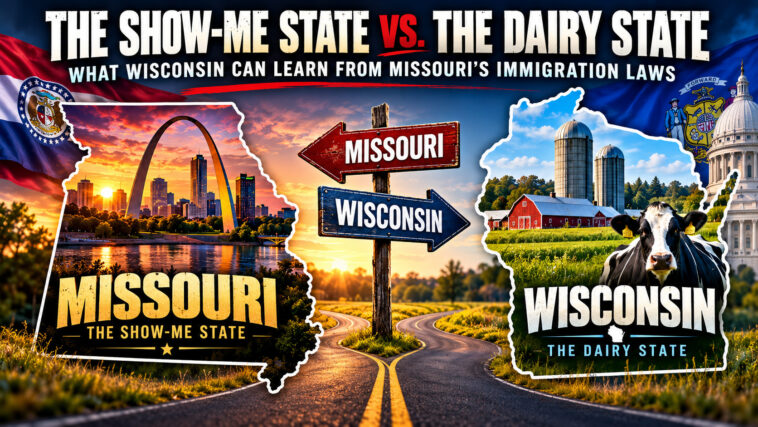
Missouri took legislative action nearly two decades ago to address illegal immigration, taxpayer-funded benefits, and government accountability. As Wisconsin debates its own constitutional future, the comparison raises questions worth examining.
Earlier this week, I wrote an editorial opposing Wisconsin’s Question 2—not because I disagree with its intent, but because our Constitution deserves more than vague language and good intentions.
Constitutional amendments should be precise, narrowly defined, and leave little room for unintended consequences or future political reinterpretation. Once enshrined in our Constitution, poorly written language can have consequences far beyond what voters originally intended.
I fully support amendments that establish clear standards and produce meaningful, lasting change. But if we’re going to change the Constitution, we had better get the language right. And that brings me to Missouri, the Show-Me State, where lawmakers and voters have taken a different approach to immigration policy and constitutional reform; one worth examining here in Wisconsin.
There is an old saying that sometimes the best way to understand what is happening in your own backyard is to look over the fence at your neighbor.
For Wisconsinites concerned about illegal immigration, government spending, public assistance programs, and the responsibilities of citizenship, that neighbor might be several hundred miles southwest.
Welcome to Missouri.
Known proudly as the Show-Me State, Missouri has an immigration policy history that deserves attention from residents of the Dairy State, particularly those questioning the expanding responsibilities of government and the financial obligations placed upon taxpayers.
In 2008, Missouri adopted legislation addressing immigration-status verification, public benefits, employment eligibility, and cooperation with federal immigration authorities.
That same year, Missouri voters approved a constitutional amendment establishing English as the language of official governmental proceedings.
These weren’t merely campaign promises. They were enacted measures with identifiable legal requirements and enforcement provisions.
But did they accomplish what their supporters intended? And which, if any, offer useful lessons for Wisconsin?
The Missouri Constitutional Amendment: Let the Voters Decide
On November 4, 2008, Missouri voters considered Constitutional Amendment 1.
The proposal established English as the language used during official proceedings of public governmental bodies.
The results were decisive.
Approximately 86.3% of voters supported the amendment, with more than 2.4 million voting in favor and approximately 382,000 opposed.
The amendment became Article I, Section 34 of the Missouri Constitution.
Its application is important to understand. The constitutional language covers official government meetings, including proceedings conducted electronically.
Supporters considered it an affirmation of English as a common language in public governance. Few raised concerns about its possible effect on communication with residents who speak limited English, particularly during emergencies.
The broader lesson for Wisconsin lies not simply in the language policy, but in examining what government responsibilities a state chooses to define constitutionally.
Missouri’s voters made a decision about the conduct of government. Wisconsin voters, when considering their own constitutional amendments, face the same responsibility of studying precisely what any proposed language changes.
Missouri’s 2008 Immigration Law: More Than Symbolism
While the constitutional amendment attracted public attention, another major development occurred in Jefferson City.
In July 2008, Missouri Governor Matt Blunt signed House Bill 1549, a substantial package of immigration-related provisions.
The legislation addressed several areas of state government:
Law enforcement: The measure required immigration-status verification through federal authorities under specified circumstances for people charged with crimes and held in confinement. It also directed the Missouri State Highway Patrol to pursue federal immigration-enforcement training arrangements.
Government benefits: Missouri reinforced restrictions on certain state and local public benefits for people unlawfully present in the United States, while preserving legally required exceptions.
Employment: Employers faced penalties for knowingly employing unauthorized workers. Public employers and businesses seeking state contracts are subject to federal work-authorization requirements.
Local government: Missouri restricted municipalities from adopting certain sanctuary policies and attached state-funding consequences to prohibited actions.
Driver’s licenses: The law restricted licensing for people unable to establish lawful presence.
Clearly, Missouri placed its position into law.
Public Assistance: Who Qualifies, Who Pays, and Who Decides?
One of the strongest arguments for Missouri’s approach concerns taxpayer-funded assistance.
Missouri Revised Statutes Section 208.009 establishes restrictions on state and local public benefits for all individuals unlawfully present in the country.
Missouri also established verification and certification requirements for public postsecondary educational benefits.
Public institutions awarding covered educational benefits must verify qualifying immigration status and certify compliance annually.
The policy question is straightforward:
What assistance should government provide, who should qualify, and what documentation should taxpayers reasonably expect?
Constitutional Amendments: Wisconsin Should Pay Attention to the Fine Print
This brings us to a particularly consequential question for the Dairy State.
Wisconsin’s Constitution is not an ordinary statute.
Under Article XII, Section 1, proposed amendments generally must pass two successive legislatures before being submitted to voters for ratification.
The governor’s signature is not required for that constitutional-amendment process.
That makes the ballot questions like Question 2 especially important.
Missouri’s English-language amendment provides a useful case study: voters approved a defined change addressing official government proceedings, while the text itself placed limits on its application.
When Wisconsin voters are presented with constitutional amendments involving government authority, public spending, civil rights, or eligibility requirements, they should examine whether the wording accomplishes the stated purpose.
Does the measure establish a clear constitutional rule? Does it create unintended consequences? Could the issue instead be addressed through ordinary legislation? What safeguards remain?
And perhaps most importantly, what government powers or restrictions will endure long after the political debate that produced the amendment has faded?
Those questions apply regardless of which political party authors a proposal.
What Has Missouri Actually Demonstrated?
Missouri’s experience provides several concrete subjects for Wisconsin residents and lawmakers to study.
Its 2008 legislation demonstrates how a state can combine employment verification, public-benefit restrictions, immigration-status checks, and cooperation with federal authorities into a broader statutory package.
Its constitutional history demonstrates how voters can establish a specific rule governing official state proceedings.
Supporters of stricter enforcement saw an important distinction between public assistance that government is legally obligated to provide and additional benefits that states may choose to fund.
Opponents pointed to administrative costs, family consequences, public-health needs, and the danger of treating legally present immigrants or U.S.-citizen family members as though they were ineligible.
Ultimately and overwhelmingly the we the people, people spoke. Today it is very clear that Missouri has much to show for it when compared to it’s neighboring states.
From the Show-Me State to the Dairy State: The Questions That Remain
Perhaps Missouri’s most relevant lesson is found in its nickname.
Show me.
Show me what the legislation actually says.
Show me what the Constitution actually requires.
Show me which public benefits are restricted, which remain available, and why.
Show me the enforcement figures.
Show me the costs, the savings, the lawsuits, and the measurable results.
Show me whether Wisconsin and Missouri differ greatly.
And before asking voters to permanently alter their state Constitution, show them exactly how the amendment is defined and how it’s language will operate once it becomes law.
The discussion is bigger than Missouri or Wisconsin. It concerns the relationship between citizenship, residency, taxpayers, public assistance, constitutional authority, and the rule of law.
Missouri has supplied nearly two decades of legislation and policy experience for Wisconsin to examine.
Whether those policies should be replicated, modified, or rejected is a decision that deserves more than a viral social media message.
Because when the future of a state is at stake, “Show Me” shouldn’t be just Missouri’s nickname. It should be the standard demanded by every informed Wisconsin voter.
That just makes common sense. Wouldn’t you agree?